

On Launching a Journal in the Present Circumstances
By D. Seiple

Towards the end of the summer weather in 2024, the New York City Philosophy Club began meeting twice a month, and by mid-autumn our attendance on the Lower East Side was close to a hundred bodies, dispersed into huddled discussions of three or four. At the outset of each meeting, each of those random clusters was handed some very short quotes and some very gentle options for expanding the discussion – on topics like “Justice,” or “Harmony” or “Consciousness.” The result has been a lively expression of individual points of view and a fruitful opportunity for networking. And the numbers of our participants over the past year seem to be increasing almost exponentially. We now host meetings on a weekly basis across the New York metropolitan area.
There is no expectation of sticking to anyone’s particular agenda in these sessions, for our diversity is our strength, certainly. And for a number of us, doing philosophy amounts to just this -- offering our latest musings, which fly forth like sparks off a bonfire. Very often what gets uttered in the moment gets dimmed in the memory. Still, personal connections often linger beyond the heat of the evening. And that’s all to the good.
However in addition to a splendid networking opportunity, for many of us these discussions have shown the advantage of sustaining a conversation over time and paying closer attention to the form those conversations take. We began to see that many of our best thoughts were soon lost, and even for the recaptured remnants, the original spark may well have turned its brightness elsewhere.
So conversation is not enough. If we had memories like Socrates, we might deplore the invention of writing as a weakening of the mind. But it’s late in the cultural day to turn those sails around. Perhaps then we’d better pin down our best thoughts, so that others can take them seriously. Writing philosophy might be a necessary complement to simply talking it all out.
Hence, this journal.
**
This is not a standard philosophy journal, as it contains submissions of a more literary nature as well. This is because there is certainly more to good philosophy than just logical argument. Literature aims to draw us into a larger scope than just the precise premises of a proof: literature is about our lives. Philosophy can be as well, but then any writer of either philosophy or literature might need to take a wide look around to see where their own life is situated. Otherwise they might be just writing sad songs in an echo chamber.
So where are we? Culturally speaking, we might notice how many successful members of the Boomer generation, who witnessed the first influx of the Mamas and the Papas and the flower children, seem to have largely settled back into the cozy lives the American Dream had promised them. They may smile, wistfully, at their own naivete back then, when John and Yoko were proclaiming that all you need is love and touting the power of imagination. But these days many among the present younger generation might be wishing for just a bit of that same imagination, now that any solid future of their own may feel hard to imagine at all. We all know that we’re living in an age of transition, and at such times it’s hard to know exactly where we are or where we may be going.
But what, you may ask, does all this have to do with the launch of a new journal?
Here is where a little history might be helpful. Human history is not linear. Progress has never been a straight line. And at those transition points, when everything seems up for grabs and nothing seems solidly predictable, a new age of promise bursts forth only when individuals share each others’ visions of new understandings, once they notice that the old ways of looking at things may not be working. This is exactly where the contributors and readers of a journal like this might notice themselves to be.
The early decades of the 19th century in Europe were an age rather like ours today. The period between 1776 and 1848 has been called the Age of Revolution, and the first journals (both philosophical and literary) had only recently made their way into the public awareness. Just as Luther’s Reformation in the 16th century was made possible by the advent of the printing press, so the change in broader consciousness that so informed the social transformations of three centuries later was invigorated by published writers – and this could not have happened without those journals.
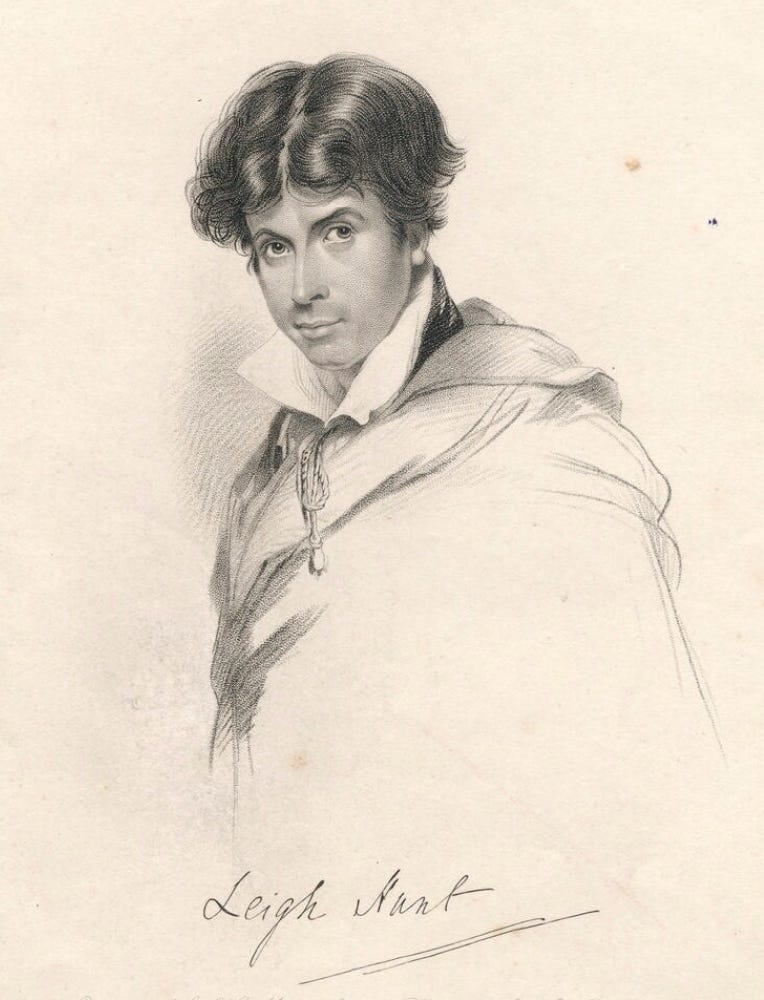
Those writers found a home within the pages of magazines like Leigh Hunt’s Examiner (1808-1821). Hunt was a poet and literary critic who introduced the world to the John Keats, Percy Bysshe Shelley, Robert Browning and Alfred Tennyson – poets whom later generations have since lumped together as “Romantics.” These writers had common artistic and social concerns that rather suddenly developed and rather dramatically contrasted with what had existed before.
How did this happen? Clearly there was a radical cultural change in the air, one that the eminent historian of ideas Isaiah Berlin called “the greatest single shift in the consciousness of the West that has occurred.” Beforehand, everything was thought to be part of some great unity – even if there was no agreement on what that unity was. But after the Romantics, in many quarters, there seemed to be only competing subjectivities.
It doesn’t take too much imagination on our part to see the parallels with our own situation today.
Although the radical social upheavals of that era certainly paved the way for this development, it would be a rash reductionism to deny that the shift in consciousness itself played an indispensable part in that story, as it appears to be in our own as well. Berlin himself viewed romanticism as the triumph of diversity and pluralism. Perhaps this journal can be a home for those who share a similar sensibility, and even for those who might not.
Further comments are invited!
.
Artwork: A drawing by J. Hayter
D. Seiple is Chief Editor of the NY Journal of Philosophy. He especially enjoys symphony concerts and pre-postmodern art museums. He has a master’s degree in theology (Drew) and a doctorate in philosophy (Columbia), and his publications can be found on PhilPapers.