


Addressing the problem of Ireland’s large population of unemployed poor, and the increased burden of their reproduction, Jonathan Swift suggests an economically based solution: “[A] young healthy child well nursed, is at a year old, a most delicious nourishing and wholesome food, whether stewed, roasted, baked or boiled.”1
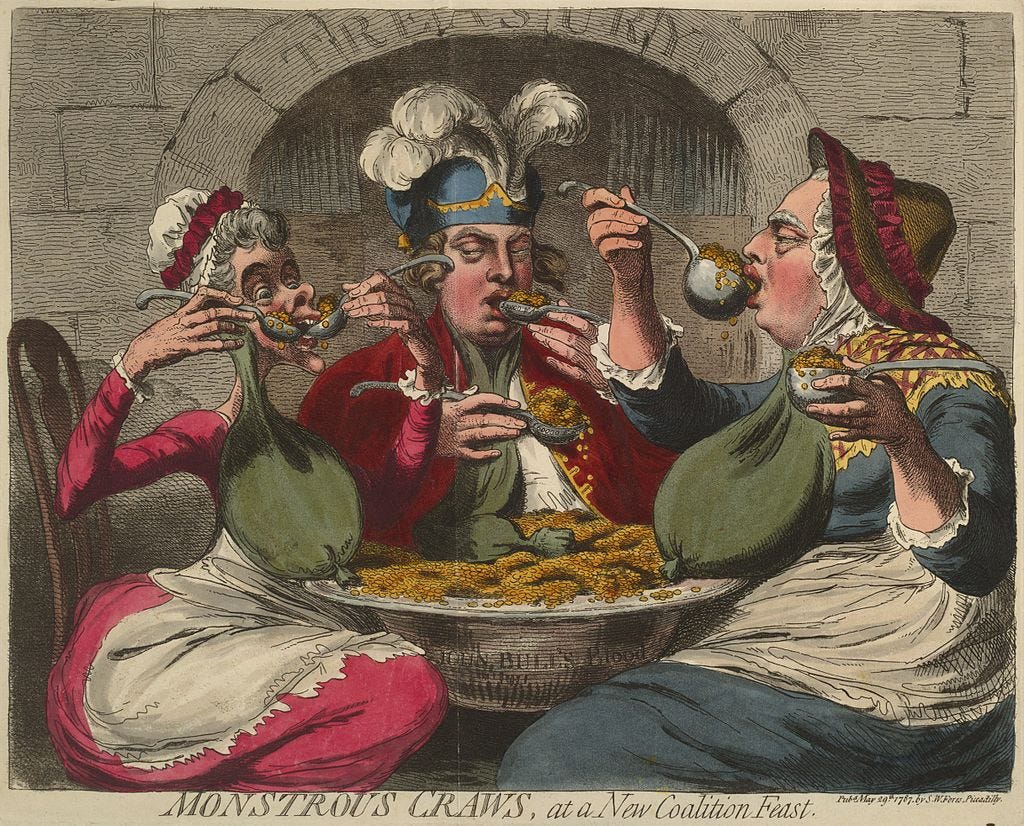
Swift’s essay is meant to be farcical and horrific, to shock readers at the cruelty of the British colonial mindset. And yet, its core ideas—that we must calculate each life’s cost, and that some lives are not worth that cost because they do not produce enough capital or good to the nation—are not as far from emerging ideologies of our own time as we may believe.
“[I]t’s your patriotic duty to be as healthy as you can,” says Dr. Oz, Trump’s overseer of Medicare and Medicaid. Oz demands that health care dollars be allocated “efficiently” because “we’re not getting our money’s worth.”2 Implicit in Oz’s philosophy is the inevitable conclusion that we must not support patients whose medical needs or conditions make them “inefficient.” If health is a patriotic duty, and we value efficiency above all, some lives do not make the cut. While measuring the cost efficiency of life was mocked by Swift in 1729, it was a vital part of public policy in Nazi Germany two centuries later.
More recently, in our own country, the concept revived in the writings of Peter Singer. And it is now embraced not only by official government but by the unimaginably powerful Silicon Valley Tech aristocracy under the seemingly innocent guise of effective altruism. In this essay, I will track this train of thought, exploring how we have gone from Swift to Oz, while the transitive tissue was people trying to do good efficiently.
§
The largest “savings” claimed by the Department of Government Efficiency (DOGE), led by the Silicon Valley titan, Elon Musk, is slashing the Department of Health and Human Services (HHS), the agency charged with providing “health and human services and sustained advances in the sciences underlying medicine, public health, and social services.” The ideologies evidenced by DOGE, Musk, and Oz are, ironically, tied to a movement for social good that bewitched Silicon Valley, effective altruism (EA)—and to eugenics. EA’s “Data-driven approach” entails the concept that money must be allocated in a seemingly objective manner to provide what someone deems to have the greatest impact per dollar. In measuring efficiency, one must perforce value lives relatively, i.e., one must quantify intangibles such as pain, happiness, and the value of a life itself. By tracing the history of EA, we can see the philosophical path that has brought us to our current moment where government approaches Swift without the irony.
In October of 2015, I stood in a retrofitted warehouse in San Francisco arguing about effective altruism—a phrase I had heard but never stopped to understand—with what, at the time, was considered an admirable master of the universe: a startup founder. In some ways, he was the ideal tech founder. He was young, handsome, slightly reckless, and created his startup after an epiphany about “disrupting” a small part of life. In other ways, he was atypical; his startup was a nonprofit. His team members weren’t there to make ungodly sums of money for themselves and their investors. We were implementing crowdfunding for the less fortunate. We were implementing “tech for good.”
I came to the start up through a Stanford English department newsletter advertising an Editorial and Content Internship at “a new crowdfunding nonprofit funded by Y Combinator.” Fully ensconced in my humanities bubble, I’d never heard of Y Combinator or even crowdfunding. My only experience with tech was writing a paper about the dangers of electronic medical records. And yet, I got the internship.
At the startup I wrote public facing profiles to attract donations. I loved the energy of a group of youngish people using their highly specialized skills to help people, while also providing donors the satisfaction of knowing their money was having a direct, outsized impact. I didn’t think much more about it than that. I certainly didn’t ponder Effective Altruism.

The startup’s Halloween party was after my internship ended. I’d never spoken with founder one on one, but we ended up in a corner and he said something about how happy he was that Effective Altruism was catching on with the public. Emboldened by his casual manner, I admitted that I didn’t know what Effective Altruism was. He laughed, “You really worked for a tech company inspired by Effective Altruism, and you knew literally nothing about either?”
“Well, I figured it was fine since I was writing, and the rest of you know nothing about words.”
As he swayed slightly, he explained, “Effective Altruism is a theory that we are obligated to do as much good as possible, that it’s ethically mandatory to give in the most effective way. For example, malaria nets cost so little, but they literally save lives. For $2 a net you can save a life. On the other hand, if you donate to another cause that might save a life for $200,000 you’ve literally passed on saving 99,999 other lives. Effective Altruism tells you to donate to the cause that saves a life for $2, instead of the cause that essentially wastes money on fewer lives.”
I was quiet as my brain processed what he’d said. I wasn’t a philosopher. I studied creative writing, literature, and history. I wrote about the Holocaust, and my life with chronic illness and disability.
The founder’s words caught in my chest, though I wasn’t yet sure exactly why.
“You can’t really say that a life is worth $2.”
“What do you mean? Of course, I can.”
“The mosquito net is worth $2, sure, but that isn’t the value of the life. The worth of a life can’t be quantified, or shouldn’t be. You can’t say that it’s wrong to put money into expensive research that might—or might not—cure cancer. You can’t say that a cause which doesn’t even save lives but makes them better is wrong. My Dad volunteers with Make-A-Wish. Is that wrong? Is he unethical to do that instead of soliciting money for malaria nets?”
Unfazed by my vehemence, he replied, “I’m not saying that it’s immoral but it’s not really ethical. You must do the most good possible. Make-a-Wish spends hundreds or thousands of dollars to make one kid happy. Those dollars could have saved the lives of many other kids. You’ve read Peter Singer, right? It’s his theory. All EA is based on his writings. He wrote the book on it, literally. He’s brilliant. You should read The Most Good You Can Do.”
He sounded logical. But what he said, or maybe the way he said it, was pulling at me. Did he really believe we should quantify lives in dollars and cents? Did he really see nothing dangerous about insisting that such accountings were morally imperative? I’d lived my life on the bad end of a medical bell curve. I didn’t want to be part of a world that bowed to statistics as the be all and end all. In The Logic of Effective Altruism Peter Singer argues that “living a fully ethical life involves doing the most good we can.”3 Singer defines the most good as a “world with less suffering and more happiness.”

Over time, despite my reservations, and without fully realizing it, I absorbed the ideas of EA. I had decided that a few brilliant people in Silicon Valley could change the world. I had bought into the idea that doing good was about quantity.
Several years later, hoping to “scale up” my good, I worked at a foundation established to distribute grants to organizations implementing Effective Altruism to “do good well.” The foundation was passionately dedicated to the concepts of EA. I thought it was my chance to “scale up.” Instead of doing good through a single nonprofit, I’d help grant funding to dozens of them. I believed in the founder’s mission to quantify giving, to use data to evaluate charities and share that data with donors. I trusted that we could save the world with data-driven altruism.
Over time at the foundation, I became increasingly uneasy. I wasn’t sure if I was doing much good, let alone doing it well. In a beautifully appointed office in the heart of the Valley, I was using a narrow set of tools to examine the most complex and systemic issues. In hours of discussions with colleagues over how to make the world better through efficient and data-driven giving, I began to doubt more. Yes, it made sense to ensure that nonprofits used their money wisely. And it made sense to find effective solutions to pressing problems. But as I pored through websites and charts that applied cost—benefit ratios to suffering I felt wrong. Did we truly believe we could objectively quantify pain and rank suffering? By what criteria were we to decide whether cancer was “better” or “worse” than malnutrition or that the foster care system in America deserved less funding than orphanages in Romania? If our philosophy was that we could rationally and confidently make such choices—could assess which suffering matters more—didn’t that mean that we were creating a cutoff point below which sufferers were unworthy? And, if they were unworthy, what should be their fates?
That the foundation was by, of, and in Silicon Valley was no coincidence. Economist Peter Coy explains effective altruism as “a new movement inspired by philosophers (including Peter Singer…) and embraced by Silicon Valley engineers who pride themselves on taking a logical, data-driven approach to life. [With] emphasis on issues it describes as important, neglected, and tractable.”4
Peter Singer inspired the royalty of Silicon Valley. Facebook co-founder Dustin Moskovitz established Good Ventures and Open Philanthropy to “answer a fundamental question: how can philanthropic giving achieve the greatest impact.”5 Laura Arrillaga Andreessen, whose family name is on multiple buildings at Stanford and who is married to PayPal co-founder and leading venture capitalist Marc Andreessen, has long championed Giving 2.0, a data-driven, philosophy of giving deeply connected to Singer’s version of Effective Altruism. She argues that “giving away money is easy, doing so effectively is harder.”7 Other tech world followers include Jaan Tallinn, the founder of Skype, pre-scandal Sam Bankman-Fried, and, Elon Musk, who has said that his philosophy “closely aligns” with effective altruism. The data of the “data-driven approach” is a search for how to allocate money where it has the greatest impact per dollar given. To decipher this enigma, however, we must have something to measure the dollars—and the impact—against. We must quantify intangibles such as pain, happiness, and life itself. To understand how this plays out, it is useful to look back at where this idea got its start, the unofficial founder of effective altruism, Peter Singer.
§

Singer is an Australian utilitarian philosopher and Professor Emeritus of Bioethics at Princeton’s University Center for Human Values. Though best known to the public for advocating more humane treatment of animals, Singer’s core focus is a new ethical code for all living creatures.
Utilitarianism judges actions not on any inherent moral basis—such as religious ethics—but by the net pain or happiness the actions create. In Practical Ethics, Singer applies this ethical framework to formulate a societal approach to major issues including “euthanasia, and the obligation of the wealthy to the poor.”6 Singer makes two key assumptions. First, happiness and pain can effectively be judged, measured, and ranked. Second creating happiness and avoiding pain are the most important objectives in any decision.
Following upon these seemingly innocuous ideas leads Singer into the dangerous territory of not only assessing a “value” to individual lives but advocating the power to make such value decisions for others. Thus, explains Singer, the “classical utilitarian might have to accept that in some cases it would be right to kill a person who does not choose to die on the grounds that the person will otherwise lead a miserable life.”7 Singer is entirely comfortable with that; indeed he considers such fatal judgments to be morally imperative, “there is nothing directly wrong in conceiving a child who will be miserable, but once such a child exists, since its life can contain nothing but misery, we should reduce the amount of pain in the world by an act of euthanasia.”8 (Emphasis added) Under this theory, writes Singer, the “incurably ill or severely disabled infants, and people who through accident, illness, or old age have permanently lost the capacity to understand the issue” can, and theoretically ought to, be euthanized.9
Singer does not limit his death sentences to extreme cases, such as an accident victim without brain function or a newborn whose lungs have not formed. Infants whom society should be able to kill include the disabled, such as those with spina bifida, a condition Singer considers as precluding the possibility of optimal or acceptable levels of happiness since it can cause paralysis and loss of control over the bladder and bowels.
I will show my hand. I was born with a tethered spinal cord—closely related to spina bifida. I had no control over my bowels or bladder. When I was in kindergarten, I had a successful operation to untether my spine. I regained normal nerve function. And yet, perhaps unbelievable to Singer, I have joyous memories of my life before the operation. I remember my father taking me for chocolate milkshakes on Saturday afternoons. I remember watching TV with my mother, cuddling against her on the couch while sharing bowls of popcorn sprinkled with M&Ms. I remember making snow angels with my sister, watching with delight as she laughed in the fresh snow. I remember so much joy—joy undiminished by having to go to the bathroom every hour and wearing pull up diapers at night. So, let me ask, whether it would have been moral for my parents to apply Singer’s “practical ethics,” to euthanize me for replacement with “another infant with better prospects of happy life?”10 This debate cannot help but remind us of the ending of Swift’s “Modest Proposal,” in which he satirically writes, “I desire those politicians who dislike my overture…that they will first ask the parents of these mortals, whether they would not at this day think it a great happiness to have been sold for food at a year old…and therefore have avoided such a perpetual scene of misfortunes, as they have gone through.” A satirist, Swift is not actually suggesting it is better to kill infants than to let them live a marginalized life, Singer is.
And Singer goes even beyond disabilities that impair function. Writing of a hypothetical hemophiliac, Singer admits that hemophilia is not a disabling disease in the normal conception. It causes pain and danger, but not intellectual disability or physiological impairment. Yet Singer marches on, arguing that by nature of being sick, a hemophilic is less likely to have a happy life than a “normal child.” Therefore, he concludes parents ought to have the right to kill a hemophiliac infant because, “if killing the hemophiliac in fact has no adverse effect on others excluding the infant, it would, according to the view be right to kill him.”11 Singer anticipates, and rejects, opposition “it may be objected that to replace either a fetus or a [disabled] newborn infant is wrong because it suggests to disabled people living today that their lives are less worth living than the lives of people who are not disabled yet it is surely flying in the face of reality to deny that, on average, this is so.”12 Singer affirms his personal ability, and, perforce, that of the society he envisions, to know and judge the value and affective experience of another, to score the value of one’s fellow humans. That those scores determine life or death is not only fine with Singer, that’s what he forcefully advocates. It’s all a mathematical exercise, and some people just don’t make the cut. No wonder Singer appeals to Silicon Valley. No wonder DOGE, a beehive of Valley disciples, strikes its most destructive blows on HHS.
§
After my spinal cord surgery, I spent six years completely healthy. In middle school, however, I began to experience symptoms of what, years later, would be diagnosed as a clustering of related neurological and autoimmune illnesses. Undiagnosed and untreated the conditions were excruciating. Even with treatments, I spend much of my day in pain. I plan every aspect of my life around disease management. And yet, other than when faced with misdiagnosis, unsupportive schools, or relatives who don’t understand my condition, I’ve never been unhappy. I’ve enjoyed countless hours with friends over tea. I’ve read books, written essays, and debated issues with brilliant professors and peers. I’ve earned two degrees with honors at Stanford. I’ve watched my sister become a mother, and played often with my niece and nephews. I’ve watched them grow and become their own distinct persons.
I cannot do everything “healthy” people can. But I can have and create joy. Traveling across the spectrum of disability I’ve never once doubted that my life has been equally worth living as those of the fully abled. And so, as we examine the thought patterns of Effective Altruism and assumptions behind them, we must grapple with these facts. How many points does my disabled but happy life score? Do I make the cut? Who decides? What happens to me if I don’t hit the target?
Practical Ethics was met with particular resistance in one place—the former Third Reich, where disability advocates argue his philosophies are not a new step forward but a familiar fall back.
Singer protests comparison to Nazi Germany because the Nazi state decided who lived and who died, while Singer puts that power in the hands of parents or legal guardians. But where is the logic of this distinction? There is none. First, since Singer is not advocating complete freedom to kill any child, his theories necessarily implicate the state. The state would have to establish standards for parents to make the fatal decision; otherwise, parents would be free to kill perfectly abled children for any motive—cost considerations, the child’s gender, or whatever else might make the death convenient for the deciders. Second, if eliminating the disabled furthers the interests of society as a whole—as Singer claims—then doesn’t society, i.e., the state, have the right, indeed the duty, to compel appropriate eliminations? Why should individual parents, heedless of society’s best interests, be able to selfishly impose on the state the costs of special education, medical care, and other special needs of a child who should have been disposed of? And, even if the state chooses to deny these benefits to the unworthy, i.e., the disabled, something has to be done with them.

Singer’s—and Nazism’s—philosophical antecedents, the eugenicists of the past two centuries were quite explicit that society was obligated to cleanse the populace. In the late 1800s, Stanford President David Starr Jordan advocated the “evolutionary obligation of humanity to cull the least productive of its members.”13 In 1915, University of California professor SJ Holmes wrote in The Atlantic of our “social duty to eliminate our hereditary defectives.”14 In Germany in 1920, the authors of Permission to Annihilate Unworthy Life advocated for killing “total idiots in the population.”15 In 1933, Nazi Germany commenced a program of enforced sterilization. The enabling legislation explained that “inferiors and those suffering from hereditary conditions” were reproducing, creating children who would be burdens to the rest of civilization.
Since “inferiors” unduly burdened the community, sterilization was not enough. Over 70,000 “inferiors” were murdered under the government’s T-4 program.16
While the language of the eugenicists and the Nazis is uglier than Singer’s, the bottom line is unchanged; not only is there such a thing as “unworthy life,” the state has a duty to purify itself.
§
Effective Altruism is not bad per se. As flawed as its foundational thinker—and some of its preconceptions might be—a movement whose goal is to get people to do more good, is, in many ways, good. And yet, when Silicon Valley titans came to Washington, my experiences left me unsurprised at the outcome. If one believes fiercely in data, in the idea that all aspects of human life can be measured, quantified, and ranked, it is not a far leap to, consciously or subconsciously, assume that some lives can measure too low on the metric to matter. If one values innovation, “moving fast and breaking things,” and the power of the individual to change the world by doing whatever it takes to improve a mathematical bottom line, then brash individualism can easily go off the rails.

It is perhaps not coincidental that such thinking has flourished under the present administration. Donald Trump is reported, firsthand, to have asked his nephew, Fred, father to a disabled son, why Fred doesn’t simply let the boy die.
Elon Musk himself was once an environmentalist. EA led him to engage with the idea of charity predicated on data. Now, he not only leads the assault on HHS, but he also flirts with eugenics, regularly posting on X theories that race determines individual potential. One of his first DOGE hires previously posted “I just want a eugenic immigration policy.”17
DOGE’s Singer inspired approach, as described by Sophia Cai in Politico, is quite clear: “to eliminate...protective services for vulnerable seniors, chronic disease self-management education, resource centers for people who have been paralyzed or lost a limb, and one that tries to help older people prevent falls.”18 DOGE has cut funding and over 7,000 employees to the Social Security Administration, which already has an average wait time for benefits determinations of six to ten months.19 Social Security Commissioner Martin O’Malley stated that “in 2023, 30,000 people died waiting for a decision on their SSA-administered disability benefits.”20 DOGE has cut the CDC’s workforce by 2,400, and the NIH has canceled nearly 800 research projects that “no longer effectuate agency priorities.”21
These cuts plainly reflect Singer—certain lives—those of disabled people and people with or susceptible to certain diseases—are not worthy of helping or saving. The military, on the other hand, will get even more billions under the Administration’s budget proposals.
Eugenics—and the devaluation of those who fall below the line—lurks as well in Secretary Kennedy’s focus on autism, which creates “kids who will never pay taxes.”22
When Singer wrote his “First New Commandant;” “the worth of human life varies,” and that “not all members of the species Homo sapiens are persons,” he did not create a new ideology, he did not originate the idea that human life can be sorted and ranked.23 He did, however, solidify this idea with the language and reason of the twenty-first century. And when he and others translated these ideas into the ideology of effective altruism, the edict became that it is not only possible to rank lives but doing so is society’s, i.e., the state’s duty.
While cloaked in terms of “efficiency” and “cutting waste,” the road on which we are now embarked can, and may well, lead us into unimaginable darkness. If so, we cannot pretend to be surprised when it costs people their lives. People we know. People we love. People like me.
Maybe people like you.
Jen Ehrlich received her BA/MA from Stanford University where she studied literature, history, and philosophy. She is currently completing her MFA at Columbia. Her scholarly and creative work focus on disability, feminism, and technology.
Swift, Jonathan. “A Modest Proposal.” A Modest Proposal | Project Gutenberg, Project Gutenberg, 1729, www.gutenberg.org/files/1080/1080-h/1080-h.htm.
Music, Morgan. “Dr Oz Mocked for Insisting It’s Americans’ ‘patriotic Duty’ to Stay Healthy: ‘Cutting Medicare Is Unpatriotic.’” Latin Times, Latin Times, 9 May 2025, www.latintimes.com/dr-oz-mocked-insisting-its-americans-patriotic-duty-stay-healthy-cutting-medicare-582769. 2 Assistant Secretary for Public Affairs (ASPA). “About HHS.” HHS.Gov, 16 Apr. 2025, www.hhs.gov/about/index.html.
The Most Good You Can Do: How Effective Altruism Is Changing Ideas about Living Ethically. The Text Publishing Company, 2016.
Coy, Peter. “Effective Altruism is Flawed. But What’s the Alternative?” New York Times, 17, June, 2024, https://www.nytimes.com/2024/06/17/opinion/effective-altruism-philanthropy-charity.html/
Open Philanthropy. “About Us.” Open Philanthropy, 6 Mar. 2025, www.openphilanthropy.org/about-us/. Arrillaga-Andreessen, Laura. Giving 2.0: Transform Your Giving and Our World. Jossey-Bass, 2013.
ed., Cambridge University Press, 1993.
, 99-100.
Singer, Peter. Practical Ethics. 2nd ed., Cambridge University Press, 1993, 104.
ed., Cambridge University Press, 1993, 179.
, 186.
ed., Cambridge University Press, 1993, 186.
, 188.
Lombardo, Paul A. A Century of Eugenics in America: From the Indiana Experiment to the Human Genome Era. Indiana University Press, 2011, 17.
Holmes, S.J. “Some Misconceptions of Eugenics.” The Atlantic, Feb. 1915, Accessed 1 Mar. 2025.
Herzog, Dagmar. The Question of Unworthy Life: Eugenics and Germany’s Twentieth Century. Princeton University Press, 2024, 6. 18 “Law for the Prevention of Offspring with Hereditary Diseases - Virginia Holocaust Museum.” Virginia Holocaust Museum - We Remember, 17 June 2024, www.vaholocaust.org/law-prevention-hereditary/.
Florida Center for Instructional Technology. “A Teacher’s Guide to the Holocaust.” Handicapped Victims of the Nazi Era:, fcit.usf.edu/holocaust/people/USHMMHAN.HTM. Accessed 12 Aug. 2025.
Gillum, Jack, and Heather Somerville. “Doge Staffer Resigns over Racist Posts.” Wall Street Journal, 7 Feb. 2025, www.wsj.com/tech/dogestaffer-resigns-over-racist-posts-d9f11a93.
Cai, Sophia. “Doge Slashes Disability and Aging Services – Politico.” Politico, 25 Apr. 2025, www.politico.com/newsletters/west-wingplaybook-remaking-government/2025/04/25/doge-slashes-disability-and-aging-services-00311303.
Tait, Robert. “Former US Social Security Head Predicts ‘interruption of Benefits’ amid Doge Cuts.” The Guardian, Guardian News and Media, 25 Apr. 2025, www.theguardian.com/us-news/2025/apr/25/social-security-disruption-musk-doge.
Royce, Will. “Doge & Co Set Their Sights on Americans with Disabilities.” Revolving Door Project, 11 Mar. 2025, therevolvingdoorproject.org/doge-ssa-cuts/.
Noguchi, Yuki. “Doge Cut a CDC Team as It Was about to Start a Project to Help N.C. Flood Victims.” NPR, NPR, 15 Apr. 2025, www.npr.org/sections/shots-health-news/2025/04/15/nx-s1-5364897/cdc-disaster-doge-trump-layoffs-hurricane-helene.
Astor, Maggie, et al. “RFK Jr. Claimed Autism ‘Destroys Lives’. Autistic People Disagree.” New York Times, 2025, https://www.nytimes.com/2025/04/18/well/autism-kennedy-reaction.html. Accessed 26 Apr. 2025.
Singer, Peter. Rethinking Life and Death: The Collapse of Our Traditional Ethics. St. Martin’s Griffin, 2011, 190, 206.
This article misrepresents Peter Singer. It gives an inaccurate description of effective altruism and provides poor objections to the strawmen she erected.
1. Peter Singer
The author misrepresents Peter Singer’s views several times throughout the article
Example 1: The author says that Singer is “comfortable” with the view that “there is nothing directly wrong in conceiving a child who will be miserable, but once such a child exists, since its life can contain nothing but misery, we should reduce the amount of pain in the world by an act of euthanasia.” Supposedly, he considers such fatal judgments to be “morally imperative.”
Why does this misrepresent Singer’s view?
The quote is taken from a section in which Singer is describing the consequences of the “total” vs “prior existence” versions of utilitarianism. And Singer is presenting this hypothetical as an *unwelcome consequence* of the prior existence view. The full quote goes as follows (emphasis mine):
“Perhaps the best one can say [for the prior existence view] - *and it is not very good* - is that there is nothing directly wrong in conceiving a child who will be miserable, but once such a child exists, since its life can contain nothing but misery, we should reduce the amount of pain in the world by an act of euthanasia.”
Singer goes on to say that “this is, at best, paradoxical” and he considers this a “counterintuitive consequence.” So, had the author read the two pages surrounding the quote she cited (or even the 12 preceding words in the very same sentence she cited!), she would have seen that Singer was not endorsing that conclusion.
Example 2: The author suggests that Singer is in favor of giving parents the right to kill their hemophiliac infants. In support of this, she quotes another passage from Practical Ethics: “if killing the hemophiliac in fact has no adverse effect on others excluding the infant, it would, according to the view be right to kill him.”
Here, the author is misquoting what was actually written. The full quote is as follows (emphasis mine):
“[I]f killing the haemophiliac infant has no adverse effect on others, it would, according to the *total view*, be right to kill him.”
As the full quote makes clear, Singer is again describing a consequence of a particular version of utilitarianism, not endorsing it. The author’s omission of the key qualifier and the odd inclusion of the phrase “excluding the infant” suggests she is not quoting directly from the text but rather getting her citations second-hand (perhaps from an hallucinating AI?).
2. What is Effective Altruism?
The author cites Peter Singer as the “unofficial” founder of effective altruism. She does not cite any of its literal organizational founders. Had she done so, she would find people explicitly rejecting Singer’s philosophical views.
For example, according to Will MacAskill, a co-founder of EA organizations like Giving What We Can, 80,000 Hours, and the Centre for Effective Altruism, EA is defined as:
(i) the use of evidence and careful reasoning to work out how to maximize the good with a given unit of resources, tentatively understanding ‘the good’ in impartial welfarist terms, and
(ii) the use of the findings from (i) to try to improve the world.
https://drive.google.com/file/d/1rQu75k8uMFpdsp1y3JWlHP6kev3T-97N/view
Contrast this with the way the author’s acquaintance describes it:
“Effective Altruism is a theory that we are obligated to do as much good as possible, that it’s ethically mandatory to give in the most effective way.”
Will MacAskill explicitly rejects this, saying, “effective altruism makes no claims about what obligations of benevolence one has.” If you choose to help others because you’re excited about the prospect of making the world a better place, you can still be an effective altruist. You don’t also have to feel obligated to do so.
Benjamin Todd, a co-founder of 80,000 Hours, says, “‘Doing the most good’ makes it sound like EA says you're morally obligated to focus 100% on the thing that most helps others (ie utilitarianism). I think the best version of EA doesn't make any moral demands at all.”
https://x.com/ben_j_todd/status/1585615624969064449?s=20&t=JWuD42PqmO-nS50ERauPZQ
And what are the author’s objections to effective altruism?
Here’s one repugnant conclusion she suggests follows from EA:
“If our philosophy was that we could rationally and confidently make such choices—could assess which suffering matters more—didn’t that mean that we were creating a cutoff point below which sufferers were unworthy?”
Yes, obviously some suffering matters more than others—getting an arm chopped off is worse than getting a paper cut. But no, this does not mean that there is a cutoff below which sufferers are “unworthy.” A paper cut still hurts even if it’s minor. The mere fact that there is a scale of suffering from less to more does not mean that everything below some cutoff doesn’t matter. It all matters.
This misconception is central to many of the author’s criticisms. The author repeatedly expresses the concern that some people might be below some threshold, where their interests no longer matter. But this simply does not follow, neither from utilitarianism nor from effective altruism.
Another objection: The author bristles at Singer’s (and by connection effective altruist’s) assumption that we can know how others are feeling. She writes, “Singer affirms his personal ability, and, perforce, that of the society he envisions, to know and judge the value and affective experience of another.”
But, of course we can know others’ affective experiences! Why is it wrong to slap a stranger in the face? Because we know it will hurt them! Why is it good to give other people Christmas presents? Because we know it will make them happy!
We should not be solipsists—we in fact know a great deal about other people’s affective experiences. This does not mean we are perfect mind readers. We don’t know everything about how other people are feeling, and at times it might be extremely difficult. But this is different from saying we can’t know anything whatsoever.
Additional thoughts:
The author plays fast and loose tracing the history of ideas.
For example, she says that “EA led [Elon Musk] to engage with the idea of charity predicated on data” and that Musk’s philosophy “closely aligns” with effective altruism. This is another (AI-generated?) misquotation. Musk’s only favorable statement related to EA was a reference to a recently-published book by Will MacAskill. Musk tweeted of the book, “Worth reading. This is a close match for my philosophy.”
Three things are worth noting:
1. Will MacAskill’s book, titled What We Owe the Future, does not argue for effective altruism. Instead, it argues for taking seriously the welfare of future generations. The fact that Musk might happen to care about future generations does not mean he endorses effective altruism or that he’s been led to “engage with the idea of charity predicated on data.” These are entirely separate ideas.
2. Musk does not claim that the book influenced him in any way. Indeed, Musk has envisioned interplanetary colonies for decades, well before the publication of Will MacAskill’s book. And, it’s worth repeating, a concern for future generations is not the same as effective altruism.
3. Of Musk’s thousands of other tweets, he has only ever mentioned “effective altruism” twice, not in a positive way.
So it would not be warranted to say Musk identifies with or has been influenced by effective altruism, and it would be unwarranted to imply that anything Musk has done, whether with DOGE or SpaceX or anything else, is reflective of effective altruism.
In short, the article’s central criticisms rest on misquotations, misunderstandings, and guilt by the most tenuous associations. It’s unfortunate that the author’s experiences have led her to these conclusions. There are certainly important criticisms to be made of Singer and effective altruism more broadly, but these deserve more careful thought than the author was willing or able to give.
Fantastic read, thanks so much for writing Jen.
" If one believes fiercely in data, in the idea that all aspects of human life can be measured, quantified, and ranked, it is not a far leap to, consciously or subconsciously, assume that some lives can measure too low on the metric to matter."
I thought that quote got to the heart of the matter.
My follow-up question is this: In terms of policy—which is mentioned as the SV titans come to Washington and bring their beliefs—how should systems of governance prioritize lifesaving measures, in daily life, research, and also in times of great need? There is a pragmatic element to EA that I think so many people find appealing, but what do we think a viable decision-making alternative is?