



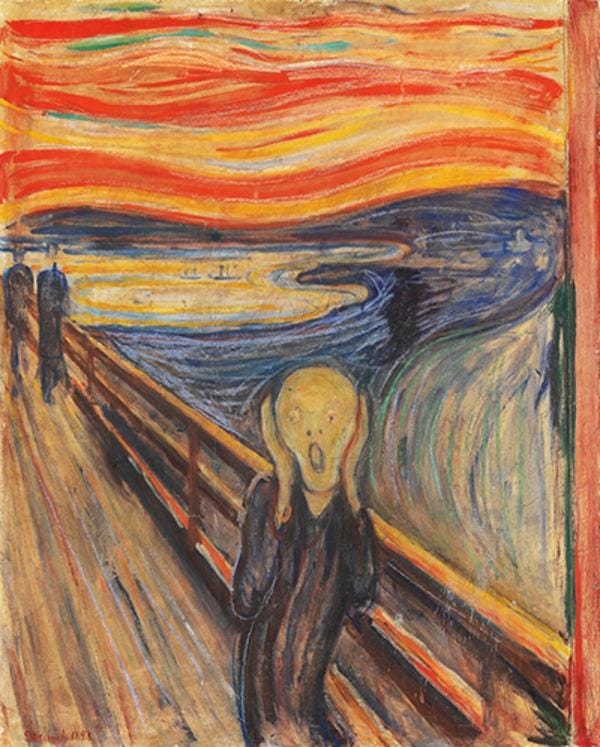
People are clearly on edge. In a recent global survey called “What Worries the World?”, everyone reported to be fretting about crime, inflation, social inequality, corruption in finance and politics, and many other troubles. Not to mention the more personal concerns, such as the moribund state of literacy and the epidemic of loneliness. Worry is everywhere, and it’s not going away.
Good. Encouraging signs of resistance begin with a sense of unease. Progress is born from discontent.
Unfortunately, a rational awareness of any problem is typically accompanied by stress, or some kind of edgy tension beneath the umbrella of “anxiety,” which, essentially, is the lovely sensation of an impending catastrophe brought on by some of your vital organs, all of which have decided to launch a mutiny against you and your sanity, determined to keep you in a stupor of angst.
Today, research shows that an alarming portion of the world has an anxiety disorder. It’s the most common mental health condition across the globe and regarded with a strictly negative connotation. Because I suffer from the American belief that anything is possible, which might also be diagnosable, I’d like to defend anxiety on the suspicion that we might have lost sight of its virtues. Anxiety is ultimately instructive. It reveals an embodied comprehension of our experience, and a reckoning with our own choices. Anxiety is, quite simply, intrinsic to the human condition, and provides the instrumental benefit of self-understanding.
The Philosophical Notion of Anxiety
There are still a few secrets you can learn from Wikipedia, especially if you are, as I am, allergic to Elon Musk’s highly derivative version. In 2017, three mathematicians put all 4.7 million Wikipedia articles through an algorithm and found that 95% of them all led back to a single entry. On any random Wikipedia page, if you click the first hyperlinked word in the article, then continue to do so in each new article, you will inevitably end up in the same place: the entry on Philosophy.
Not only is this type of empirical finding a helpful dose of vindication for those of us who spent a small fortune to study the subject at university, but it engenders a fundamental point about knowledge itself. Underneath any propositional statement is a philosophical idea. Consider the entry on “anxiety.” The first hyperlinked word is “emotion” (for skeptics, this matches the definition from the American Psychological Association). Emotions are a rich philosophical concept. They are rather mysterious, stubbornly hard to distinguish on occasion, and, even when properly identified, come in a variety of forms and flavors.
The philosophical idea of anxiety ironically has its roots in what’s typically labeled as one of the happiest countries on earth. It was in the city of Copenhagen where the Danish philosopher Søren Kierkegaard wrote Sickness Unto Death in 1849. Kierkegaard claimed anxiety was part of the human condition: “There is not one single human being who does not despair a little, who does not secretly harbor an unrest, an inner strife, a disharmony, an anxiety about an unknown,” he wrote.
Thinkers associated with the philosophical tradition of existentialism, of which Kierkegaard is widely considered to be the father, viewed anxiety as an emotional signal. Albert Camus, the French writer and philosopher, would later understand it as the vertiginous feeling that awakens us to living beyond “mechanical life.” Anxiety interrupts the weariness of monotony, especially when the world provides no inherent meaning. It discloses a harsh truth: your choices and their byproducts are your own to bear, which results in a “dizziness of freedom” according to Kierkegaard. Granted, this is not necessarily a pleasant feeling. Kierkegaard called it “a sickness of the spirit” that we carry around, which “signals its presence at rare intervals in and through an anxiety.”
Simone de Beauvoir, another French philosopher and writer, thought anxiety was especially prominent during adolescence — which she deemed to be a transition period into the “world of the serious,” which is no longer “ready-made” for us. Our decisions influence where we land in this new landscape. In her book, The Ethics of Ambiguity, she writes about the profound recognition that life is only grounded in the responsibility we give ourselves. Crucially, this lack of predetermination must be embraced.
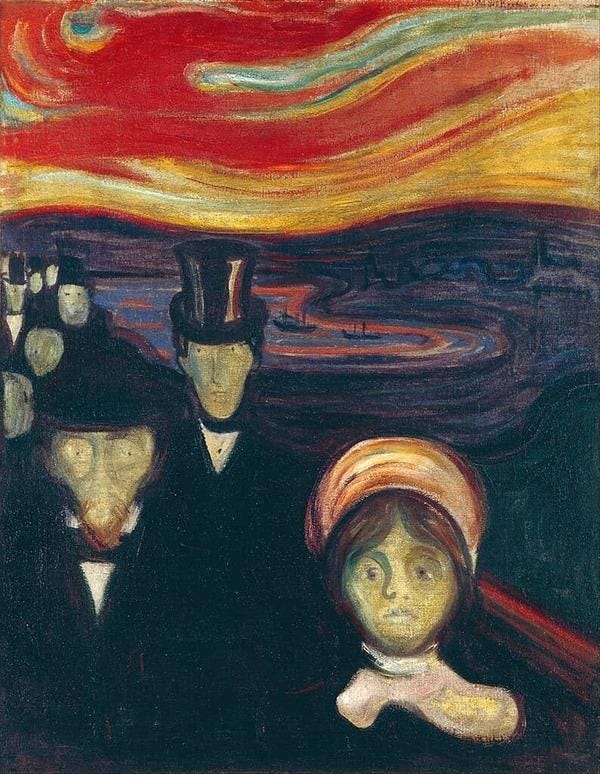
The Duty to Feel Bad
Speaking of the young, Gen Z is the most anxious generation on the planet. In 2020, a research study from Yale found that nearly 80% of high schoolers were stressed, and nearly 70% were bored. Additional research suggests these numbers are even higher after the pandemic. I did not know it was possible to be both at once, but I guess “stressed about being bored” describes young adults quite well.
“Overall,” said Marc Brackett, a co-author of the report, “students see school as a place where they experience negative emotions.” The statement is framed in a way that stirs up sorrow for the unfulfilled ideals of education and youth, but it’s also a tautology. Hell is other people, and other people are, regrettably, everywhere. The potential to encounter negative emotions will always be interminable. I’m glad the kids are catching on. Even so, some philosophers have thought we have a duty to seek out certain emotions through uncomfortable experiences.
One ethical argument for this was made by Immanuel Kant. Many people seem to think Kant had an inflexible demand to employ reason alone, and not emotions. But in fact, he argues that we should do rather unorthodox things, such as go to hospitals to see sick people, visit the poor where they live, and meet people behind bars in debtors’ prisons, all to cultivate sympathy. Kant views sympathy, along with other emotions, as instructive to our moral constitutions. Anxiety is very similar. It puts us in contact with the process of self-reflection, prompts thought about what is bothering us, and can spur us into action.
Sometimes it’s hard to identify a direct object of concern. Anxiety can easily morph into a mood; a shadow that never leaves you, which can necessarily disorient your experience of the world. Nevertheless, the source is still within yourself and your own freedom, Kierkegaard would say. Fear has a known object which threatens you from the outside, but the anxious person struggles internally.
Anxiety was given a lot of similar names in this philosophical tradition, such as angst, dread, and anguish, which are all different translations from various languages. But the concept has remained intact. Jean-Paul Sartre, the French existentialist, called it “the vertigo of possibility.” It can be nauseating to realize, or even conceptualize, the freedoms that await on the other side of anxiety, but why should consequential life choices lose their emotional gravity? Is this not a form of self-denial? Our digital age, for instance, offers choices to replace negative feelings with synthetic versions, or stave them off completely. Why go through an anxiety-inducing relationship with a real human when you can love an A.I.? Why sit down and daydream when your neurochemistry is craving more dopamine? And so the scrolling continues. We are anxious to be alone with our own minds.
The full perspective of anxiety in these terms promotes the value of an embodied experience. To feel the weight of any emotion reveals the extent and depth of what’s at stake. Existentialists suggest the human condition should not be without its anxious pangs. These emotions convey knowledge, and are trying to tell us something.
Beyond the Prescription
This view of anxiety is present in our common struggles, but has been drastically upstaged by the medical profession. There are, undoubtedly, cases in which debilitating symptoms prevent daily functioning and deserve proper intervention. While there is certainly a clinical threshold, the intrinsic harmfulness of the emotion itself is anything but straightforward.
In her book Illness as Metaphor, Susan Sontag mentions the dubious literature which connects emotions to diseases, primarily cancer. “Grief and anxiety,” asserted the nineteenth century English surgeon Sir Astley Cooper, are among “the most frequent causes” of breast cancer. This catastrophizing of emotions in the form of a causal link, which recent research demonstrates as bogus, is reminiscent of how women were previously deemed “hysterical” for physical and psychological symptoms that, once again, do not discriminate.
Nevertheless, medical answers subsist, and in doing so commit a categorical fallacy: Psychiatric solutions for anxiety treat the emotion as the disease.
Doctors set out to dull the typical symptoms of anxiety, which most frequently are increased muscle tension, faster breathing, upset stomach, rapid heart rate, an inability to focus, a sense of doom, trouble sleeping, etc. It is only natural, especially given the capabilities of medical advancements, to try and quell symptoms when we fall ill. However, the underlying “illness” is merely the consequence of being born as a human instead of a worm, and the symptoms, although unpleasant, notify us of a deeper life concern, even if it’s not immediately discernible. But something is certainly out of balance. In this sense, our “existential sickness” is intrinsically valuable, as part of our human constitution.
Part of my frustration is that even though anxiety is common to us all, modern life exacerbates the worst of it. The causes for the former afflictions are outside the body, and might all be located in Silicon Valley. The most recent book by the psychologist Jonathan Haidt, The Anxious Generation, points to smartphones and social media as primary culprits. The provocative subtitle posits these sources have “re-wired” childhood brains. The book has since sparked a movement, which advocates for a ban on social media use for all children before the age of 16.
What the world has done to us can dictate our ailments, and many turn to constructive modern outlets to help the disproportionate effects. Psychological treatments have proven to be very useful for anxiety disorders, along with certain antidepressants, such as selective serotonin reuptake inhibitors (SSRIs). Coping mechanisms can subdue the difficulties, too. Anxiety can be managed by regular exercise, consistent sleep routines, relaxed breathing exercises, and meditation practices.
These remedies are helpful to face the same pressures and worries that do not go away. The root cause is never eradicated, which is the inescapable responsibility for our own choices, for our own lives.
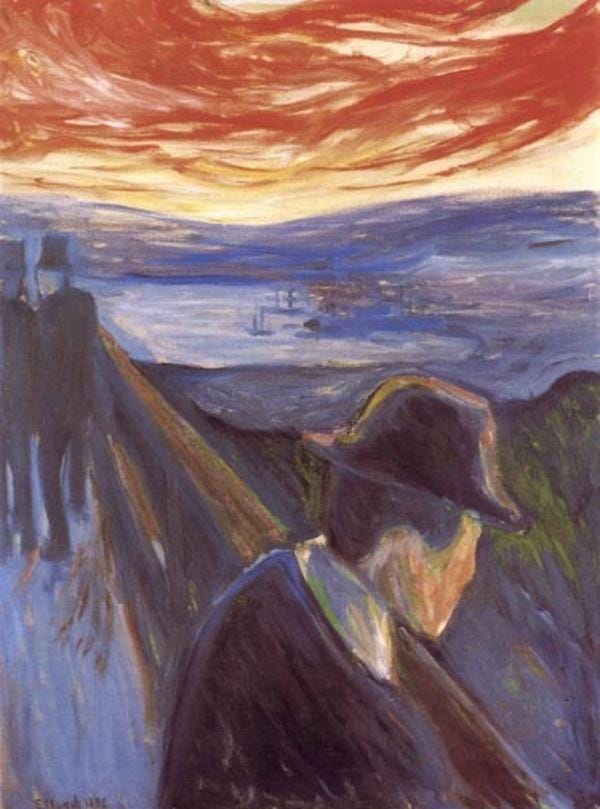
Living with the Vertigo
In 1947, the British-American poet W.H. Auden wrote The Age of Anxiety, a title that would be prescient for the decades to come. From the existentialist view, the age will never end. Anxiety is endemic. We all experience it and cannot hide from it. The doctor’s office can help when needed, but ideally not at the cost of growth. “Learning to know anxiety,” said Kierkegaard, is “the most important thing” and something each of us must confront. Indeed, de Beauvoir would affirm Gen Z in their discomfort and encourage them to walk with it and follow its directives.
Throughout history, people have struggled against the very same list of worries in the introduction and much, much else. Anxiety was plentiful during the women’s suffrage movement, the Cold War, various periods of economic and political strife, and rightfully so. Who knows how different the French Revolution would have looked if everyone had a side of SSRIs with their baguettes, but history is riddled with courageous examples of those who channeled their most existential worries into a noble resistance. It’s good that people are on edge. It means something needs to change.
In order to strive for a world without worry, we cannot expunge it from within ourselves. Anxiety informs us of our most critical gnawings, of what affects us at the core of our beings. It cuts through our secure, tranquil modes of living and challenges us from outside of that domain. Why conceal the effects of the world on yourself? What will you miss as a result? The decision to hide our worries, even if it comes in the form of pain, is the denial of being human.
The positive side to existential anxiety signals aliveness. Without it — idle in a comfortable life, filled with routines and profuse digital entertainment — we are unaware of our freedom, according to the existentialists. It’s being numbed. Perhaps we’re seeing anxiety soar because we have never been more free, and we know exactly what’s holding us back.
Jonathan Stein is a writer in a world that barely reads. Apart from trying to identify this particular strain of masochism, his work focuses on the elements of life which are threatened to be eclipsed by a mechanical and turgid future. He writes about everything at The Moronic Inferno. He holds a master’s degree in philosophy from the University of Edinburgh.
The essay is right to resist treating all anxiety as pathology. Existentialists understood that anxiety is often the emotional cost of freedom, responsibility, and self-awareness. But modern anxiety is not simply Kierkegaardian dread. Much of it is environmentally amplified. Human stress systems evolved for intermittent threats, not for permanent exposure to outrage cycles, status comparison, political catastrophe, and algorithmic stimulation. That is why today’s anxiety often feels both existential and exhausted at the same time.
The danger is not only medicalizing anxiety away, but also mistaking every form of anxiety for depth or insight. Some anxiety can sharpen reflection and moral seriousness. But much of today’s anxiety is simply what happens when evolved minds are placed inside systems designed to keep them continuously alert, emotionally reactive, and uncertain.
I think applying an existentialist interpretation to anxiety is interesting, given how differently anxiety has manifested in today's society. I would argue that, given the proliferation of technology (and especially social media), we are living in an era where we are actually less free than we have ever been. Given one's reduced time to ruminate on dreary existentialist topics such as the indeterminable gravity of one's freedom, an existentialist would posit that today's generation should suffer lower levels of the traditional form of anxiety.
Rather, however, as Haidt argues, anxiety has paradoxically only seemingly increased within the technology-dependent Generation Z. This then begs the question: Should we be redefining what anxiety really is in this modernist interpretation, or does our unhealthy attachment to technology indicate a brooding discontent with life that parallels that of our anxiety with unending freedom?
The former would be an easier interpretation -- to differentiate between 'existentialist anxiety' that we feel over the gravity of our choices and our legacies in the world, vs. 'everyday anxiety', which manifests itself trivially within the situated experience, but is not symptomatic of greater ail.
However, the latter interpretation is one that I find more interesting. Perhaps existentialists were right that humans have a knack for pondering the big questions about meaning, rain or shine, technology withstanding or not. Our technological devices seek to reduce our autonomy, insofar as we have become attached to these gadgets in lieu of the productive activities that our ancestors have historically engaged in. However, perhaps it is the case that we are acutely aware of this foolish dependency, hence enabling us to question our agency (and the missed potential of such agency) even more. I recall examples of multitudes of people who have wasted their professional careers doing jobs that are nowhere aligned to their 'true passions', and the severe dissatisfaction that these professionals feel because of the knowledge of their potential in other fields. Perhaps our attachment to technology is analogous to this discontent with our own agency, and hence the greater form of existentialist anxiety for many of today's generation -- shackled by our very own choice, succumbing to the fear of the gravity of liberty through infinite dopamine renewals.