


I. Introduction: Τaraché as Modal Misrecognition
Human suffering admits of many kinds. Some suffering tracks reality accurately: the pain of loss, grief following death, fear of genuine danger. Such suffering, while painful, serves a function—it orients us to the world as it is, motivating responses appropriate to genuine threats and genuine goods. But there exists another species of suffering, what the ancient philosophers called taraché (ταραχή), that differs fundamentally in origin. This essay argues that taraché arises not from fear, desire, or grief themselves, but from a specific cognitive error: misrecognizing the modal nature of their objects.
Taraché requires precise definition. It is not merely suffering, nor merely intense affect. It is self-generated disturbance arising from cognitive error about the nature of things—especially errors concerning necessity and contingency. More precisely: taraché is painful, function-inhibiting disturbance produced by misrecognition of reality, such that the suffering lacks a sound basis in the thing feared or desired. The disturbance is “baseless” in the strict sense that it corresponds to no real opportunity for action, does not track its object’s nature, and does not serve the function the underlying affect evolved to serve.
The two fundamental forms of this error are fearing what is necessary and desiring permanence from what is contingent.
Both represent reality as other than it is. Fear of the necessary is futile because necessity cannot be averted; demanding permanence from the contingent is futile because contingency cannot be converted into stability by wishing. In both cases, affect is directed at an object incapable of responding to that affect, producing disturbance without utility.
This commits us to a crucial distinction: not all suffering is pathological or to be eliminated. Pain can be informative, morally appropriate, motivational, and reality-tracking. Grief at loss, when proportionate, honors the good lost; fear of evitable danger motivates protective action. The target of this essay is not suffering as such, but suffering grounded in error—suffering that neither corresponds to reality nor serves any functional purpose. What makes ταραχή (taraché) distinctively problematic is not its intensity but its groundlessness.
II. Conceptual Framework: Necessity, Contingency, and Degree
The terms “necessity” and “contingency” admit of degrees and kinds. At one extreme lies absolute necessity—what cannot be otherwise under any circumstances. Death as such is absolutely necessary for composite beings; this follows from what it means to be constituted of parts that can come apart. At the other extreme lies radical contingency—events whose occurrence depends on factors so numerous and sensitive to initial conditions that no prediction or control is possible.
Between these extremes lies a continuum. Conditional necessity describes outcomes inevitable given certain conditions but avoidable if those conditions can be altered. Defeasible stability characterizes goods that, while impermanent, possess sufficient durability to reward cultivation and stewardship. The argument therefore rejects crude binaries. We claim not that everything is either absolutely necessary or radically contingent, but that fear and desire must be scaled to the degree and kind of responsiveness their objects actually possess.

This yields what we may call the Proportional Principle: to the extent something is necessary, it is not the proper object of fear; to the extent something is contingent and impermanent, it cannot be the proper object of a desire for permanence. The proportionality here is genuine. If a harm is ninety percent necessary given present conditions but ten percent avertable through effort, some fear may be appropriate—but far less than if the harm were largely contingent. Similarly, if a good possesses substantial stability over the relevant time horizon, attachment to that good is more warranted than attachment to something radically ephemeral.
Accurate modal cognition is therefore essential, not optional, for appropriate affective response. One must know—or make reasonable estimates about—the degree to which feared outcomes can be averted and desired goods secured or sustained. Errors in either direction produce dysfunction. Overestimating necessity produces fatalism and passivity where action could make a difference; underestimating necessity produces futile struggle against the inevitable. Overestimating permanence leads to devastating collapse when contingent goods are withdrawn; underestimating stability leads to failure to cultivate goods that could genuinely flourish.
III. Fear: Function, Proper Use, and Misapplication
Nature and Function
Fear is, in classical terminology, pain in the imagination of future evil. This definition captures something important: fear is anticipatory, oriented toward what has not yet occurred but might. This temporal structure gives fear its distinctive function. Unlike grief, which responds to accomplished loss, fear responds to potential loss—and can therefore motivate action to prevent that loss from occurring. Fear is evolutionarily adaptive precisely because it is instrumentally oriented toward avoidance. The creature that fears predators takes evasive action; the creature that does not becomes prey.
Fear is useful when and only when its object is evitable—when action responsive to the fear can avert or mitigate the feared outcome. This is fear’s proper domain: harms that are contingent upon conditions that can be altered. Fear of accidents motivates caution; fear of illness motivates hygiene and medical attention; fear of immediate danger motivates flight or defensive action. In each case, fear mobilizes attention, energy, and behavior toward outcomes that genuinely depend on that mobilization.
Misapplication
Fear becomes pathological when directed at what is necessary rather than contingent. Death as such is the paradigm case. Every composite being will cease to exist; this is not a contingent fact that might be otherwise but a necessary consequence of composite nature. To fear death as such—not this or that manner of dying, which may indeed be evitable, but the bare fact of mortality—is to direct fear at an object incapable of responding to that fear. The same analysis applies to loss as such and finitude as such. That we will lose what we love, that our capacities and opportunities are bounded—these are not contingent misfortunes but structural features of finite existence.
Why does fear of necessity produce taraché? The answer lies in the conjunction of four factors. First, fear of necessity is ineffectual: it cannot accomplish what fear exists to accomplish, namely the aversion of its object. Second, fear is intrinsically painful, a form of suffering. When fear serves its function, this pain is instrumental—a price paid for genuine protection. When fear cannot serve its function, the pain is pure cost with no compensating benefit. Third, sustained fear drains agency. The energy and attention devoted to fearing the inevitable are energy and attention unavailable for engaging with what can be changed. Fourth, fear of necessity involves cognitive error, a representation of reality as other than it is. The combination generates disturbance—pain without protection, expenditure without return, misrepresentation without correction.
Reframing
If fear of death is neither useful nor rationally grounded, what is its proper interpretation? Fear of death is best understood as love of life improperly expressed. The person who fears death intensely typically does so because life is precious to them, because they have goods they cherish and activities they find meaningful. This love of life is not the problem; it is the expression of that love as fear of the inevitable that produces disturbance.
The correction, therefore, is not the elimination of love but its redirection. Accept necessity—not as resignation but as accurate cognition of what is. Redirect the energy formerly devoted to fearing death toward living well within the time available. Retain fear only where it can function, where it can motivate action that genuinely protects the goods one loves. This reframing preserves what is valuable in the original fear—the attachment to life and its goods—while eliminating what is pathological: the futile resistance to what cannot be resisted.
IV. Desire and Love: Function, Proper Use, and Misapplication
Nature and Function
Desire and love bind us to goods. They motivate care, stewardship, and sustained engagement with what matters. Without desire, there would be no attachment; without attachment, no meaning. A life devoid of desire would not be a life of tranquility but a life of emptiness—if it could be called a life at all. The Stoic and Epicurean traditions have sometimes been interpreted as recommending the elimination of desire. This interpretation is mistaken, or at least incomplete. What the therapeutic traditions target is not desire as such but desire improperly calibrated to its object.
The proper domain of desire encompasses goods that can be secured, cultivated, or sustained—where “can be” is understood in proportion to the actual stability of the good in question. Friendship, knowledge, craft, care of loved ones: these are goods of sufficient durability to reward investment, even though they are not permanent. One can deepen a friendship, extend one’s knowledge, refine a craft, provide genuine care. Desire for such goods motivates the effort that makes their cultivation possible.
Misapplication
Desire becomes pathological not when it attaches to contingent goods—for all worldly goods are contingent—but when it demands permanence from what is impermanent. The error is not loving what can be lost; everything can be lost. The error is making permanence a condition of love, such that the love cannot survive the loss of its object. This includes even the most cherished goods: beloved persons, meaningful projects, one’s own capacities. All of these are contingent. To demand that they be otherwise is to demand what reality cannot provide.
Why does the demand for permanence produce ταραχή (taraché)? Again, four factors converge. First, desire cannot secure permanence from contingent goods; the demand is structurally incapable of fulfillment. Second, loss is inevitable; therefore grief escalates beyond its natural bounds when the underlying assumption was that loss should not occur. Third, when identity becomes load-bearing—when one’s sense of self depends on the permanence of contingent goods—the loss of those goods produces not merely grief but collapse. Fourth, the contingent nature of goods is denied rather than acknowledged, producing cognitive error analogous to treating necessity as contingent in the case of fear. This is the desire-analogue of fear of death.
Corrective Reframing
To love rightly is to love fully while acknowledging contingency, without demanding permanence as a condition of love. This is not detachment in the sense of caring less; it is detachment only from the impossible demand that contingent goods be permanent. The love itself can be as deep, as devoted, as intense as before. What changes is the implicit metaphysical assumption. One no longer assumes that the beloved—whether person, project, or capacity—will endure forever, and one’s love is not conditioned on that assumption.
This reframing preserves love while avoiding collapse. When loss comes—as it inevitably will—the person who has loved without demanding permanence can grieve the loss without being destroyed by it. The grief is genuine, proportionate to the good that was lost. But it is not compounded by the sense that something has gone wrong, that the universe has violated an implicit contract. Nothing has gone wrong; contingent goods are contingent. This is not news, but a truth that can be acknowledged in advance and that, when truly acknowledged, transforms the experience of loss.
V. Structural Symmetry
The parallel between pathological fear and pathological desire is now explicit. Fear has evitable harms as its proper object; when misapplied to necessities, it produces taraché. Desire has securable goods as its proper object (where “securable” is understood proportionally); when it demands permanence from what is contingent, it produces taraché. The structure is identical: an affect directed at an object incapable of responding to that affect, yielding disturbance without function.
This yields a general rule: an affect misapplied to an object that cannot respond produces disturbance. The formulation is deliberately abstract because it captures a pattern that recurs across many specific cases. Fear, desire, anger, hope—any affect that is instrumentally oriented, that exists to motivate action toward or away from its object—becomes pathological when directed at objects beyond the reach of action. The specific content varies; the formal structure remains constant.
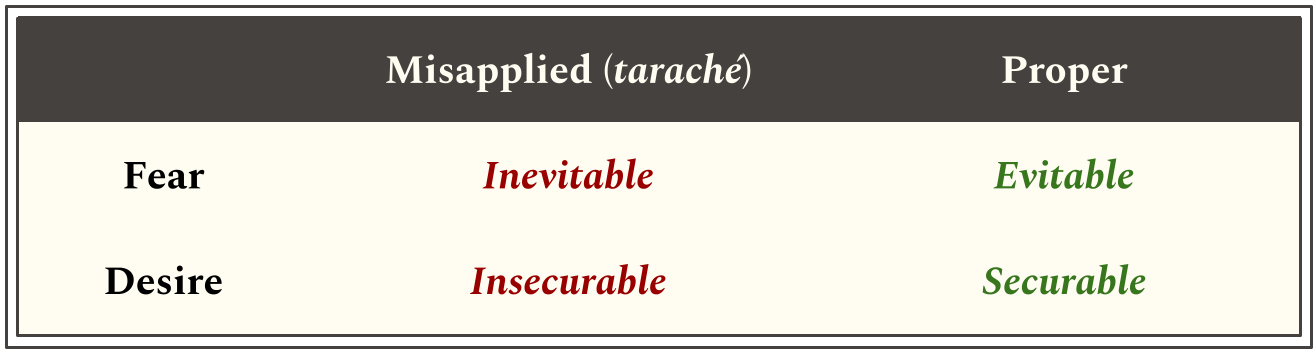
The recognition of this symmetry has both theoretical and practical significance. Theoretically, it reveals that what might appear to be distinct problems—fear of death, attachment to impermanent goods, anxiety about the uncontrollable—are manifestations of a single underlying error: the failure to calibrate affect to the modal status of its object. Practically, it suggests that the therapeutic strategies effective for one manifestation should be effective for others, mutatis mutandis. The person who has learned to accept necessity in the case of death has learned something applicable to other necessities; the person who has learned to love without demanding permanence has learned something applicable to all contingent goods.
VI. Aristotelian Synthesis: Measure and Modal Cognition
The framework developed thus far integrates with Aristotelian virtue ethics more deeply than mere analogy. For Aristotle, virtue in the sphere of affect consists in the mean between excess and deficiency. Fear admits of both: the excess is cowardice, the deficiency is recklessness. What determines the mean is appropriateness to the situation—fearing what ought to be feared, to the degree it ought to be feared, at the time it ought to be feared. Similarly for anger, for confidence, for the various forms of love and desire.
What determines “ought” in these contexts? The present analysis provides the answer: modal cognition. Aristotle’s “appropriateness to the situation” just is modal cognition, properly understood. To fear “the right things” requires distinguishing what can be faced from what cannot, what is evitable from what is inevitable. To fear “at the right time” requires recognizing when action remains possible and when it does not. The phronimos—the person of practical wisdom—calibrates fear to the structure of the situation, and that structure is fundamentally modal.
Excess fear thus arises from treating necessity as avoidable, or from overestimating the probability or severity of contingent harms. Deficient fear arises from underestimating genuine contingent dangers, from treating what is genuinely risky as though it were safe. Excess desire arises from demanding permanence from contingent goods, or from treating goods as more stable than they actually are. Modal misrecognition, not emotion itself, produces vice.
The virtuous agent, on this account, is one who fears where fear can help, loves where love can sustain, accepts what cannot be altered, and does not make contingent goods metaphysically load-bearing.
This is not a life devoid of strong emotion but a life in which strong emotion tracks reality. Such a person can love deeply because they do not make their love conditional on impossible guarantees. They can face danger with courage because they accurately assess what is at stake and what can be done. They can grieve loss without being destroyed by it because they knew in advance that loss was possible.
VII. Philosophy as Modal Training
If the analysis thus far is correct, a question arises: how does one develop the capacity for accurate modal cognition? The boundary between necessity and contingency is not always obvious. Reasonable people can disagree about whether a particular outcome is inevitable or avertable, whether a particular good is stable enough to warrant investment or too fragile to bear the weight of attachment. The spectrum is real, and reading it accurately requires a trained faculty of discrimination.
This is where philosophy enters—not as abstract speculation, not as word games, not as moralizing, but as the systematic training of our capacity to recognize necessity and contingency, especially with regard to human goods.
Philosophy, on this account, is modal training.
It develops a mental faculty: the power to subtly distinguish degrees of necessity and contingency in the situations we face, and to calibrate our affective responses accordingly. Without this training, even a person who intellectually assents to the framework developed here will remain vulnerable to ταραχή (taraché) through simple misclassification of reality.
Why is such training necessary? Because human beings are, by default, remarkably bad at modal estimation. We systematically overestimate the controllability of what cannot be controlled, and we systematically demand permanence from what is inherently transient. We fear inevitabilities as though vigilance could avert them. We treat fragile goods as though they were guaranteed. These are not occasional errors but pervasive tendencies, built into the structure of human cognition and reinforced by cultures that promise control and permanence they cannot deliver.
The ancient philosophical schools understood this. Epicurus, the Stoics, and later the cognitive-behavioral tradition all target false modal beliefs as the root of unnecessary suffering. What unites these otherwise diverse traditions is a shared diagnosis: we suffer because we misperceive the modal structure of our situation, and we can reduce suffering by correcting that misperception. Philosophy, on this view, is not primarily about constructing theories but about sharpening perception, correcting misclassification, and retraining expectation. This is why philosophy has always claimed to be therapeutic—not as a metaphor, but as a literal description of its function.
Modal cognition, however, is not merely propositional. It is not enough to assent to the proposition “death is necessary” or “relationships are contingent.” The cognition must become habitual, must sink below the level of explicit reasoning into the automatic responses that govern our moment-to-moment experience. This is why philosophy, properly understood, has always included practices and not merely doctrines: exercises, meditations, reminders, dialogues. These are not supplements to philosophical understanding but its necessary vehicles. The Stoic who meditates each morning on what might be lost, the Epicurean who memorizes the tetrapharmakos, the Buddhist who contemplates impermanence—all are engaged in the same project: training perception until accurate modal cognition becomes second nature.
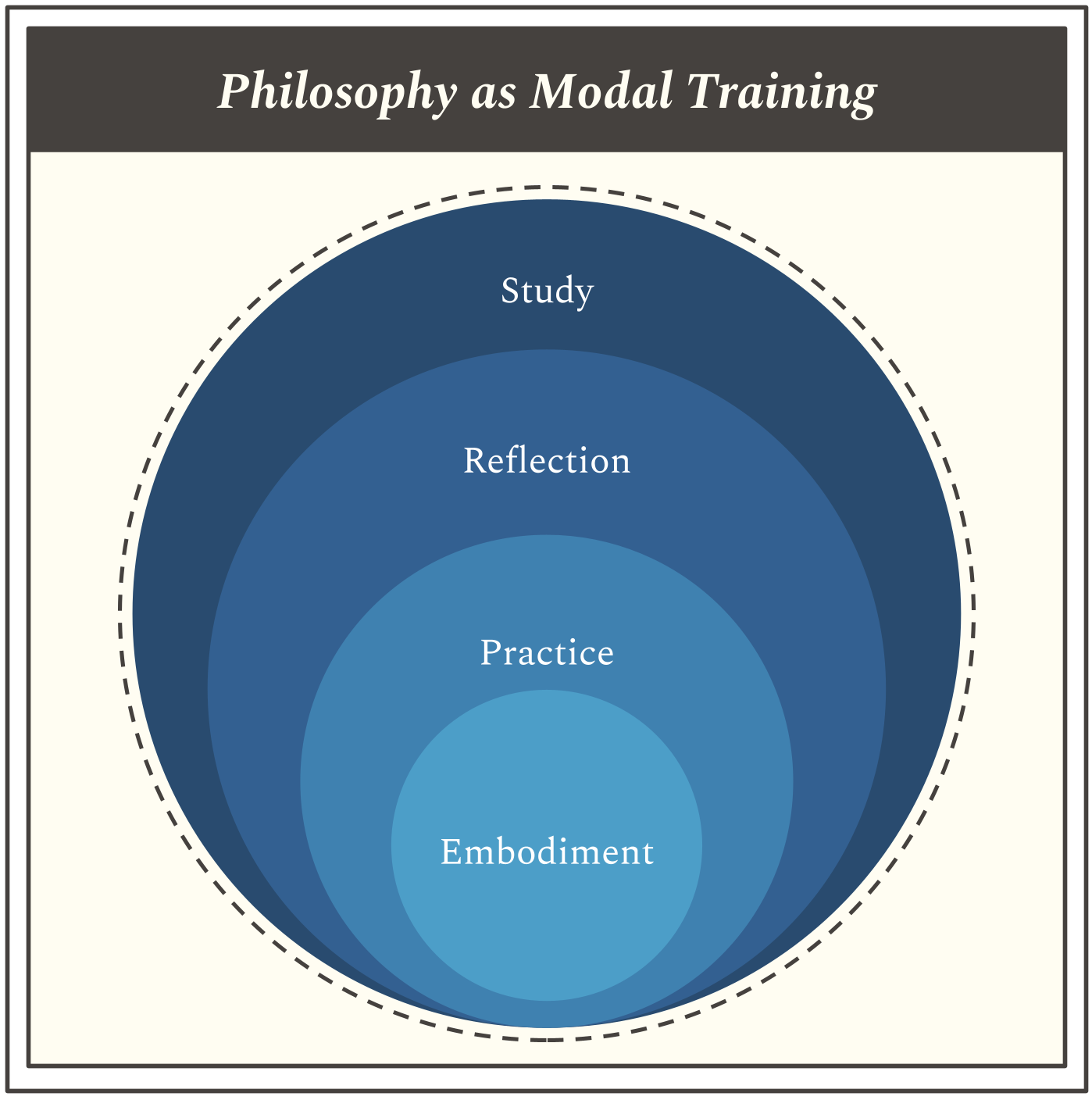
The upshot is that philosophy is indispensable for securing ataraxia because it refines the very faculty on which freedom from disturbance depends. While the boundary between necessity and contingency may initially appear blurred, philosophical inquiry—conducted not as idle speculation but as disciplined practice—allows the agent to distinguish structural constraints from alterable conditions with increasing precision. Without this ongoing study, the agent remains vulnerable to taraché through the simple misclassification of reality. Philosophy is both the diagnostic that identifies modal error and the training that corrects it. Reason guides practice; practice trains perception.
VIII. Consolation, Community, and Equality
There is a further dimension to this analysis that deserves attention: its implications for human solidarity. Necessity and loss are shared. Every human being faces the same fundamental constraints: mortality, vulnerability, the contingency of goods, the impossibility of permanent security. This commonality, far from being merely a source of private consolation, grounds genuine solidarity. We are all in the same situation with respect to what is most fundamental.
The mechanism here is worth spelling out. When a person has not accepted their own mortality and vulnerability, they experience these facts as threats—and by extension, they experience others who remind them of these facts as threatening. The sick, the dying, the bereaved, the visibly aging: all serve as unwelcome reminders of what the person is trying not to acknowledge. The natural response is aversion, avoidance, even resentment. Why must they force me to confront what I wish to deny?
Acceptance of limitation dissolves this dynamic. The person who has genuinely acknowledged their own contingency no longer experiences reminders of contingency as threats. The sick person is not an accusation but a fellow traveler. The bereaved person is not an unwelcome prophet but someone whose suffering is intelligible from within one’s own acknowledged vulnerability. What was aversion can become compassion; what was alienation can become connection. Shared finitude, once accepted, becomes a bond rather than a barrier.
This transformation has ethical significance beyond its psychological benefits. The community of the finite is a genuine community, grounded in shared facts about what it is to be a bounded, mortal, composite being. Recognizing this community does not eliminate difference—we remain distinct individuals with distinct circumstances, capacities, and goods. But it establishes an underlying equality that cuts beneath social hierarchies and contingent distinctions of fortune. Before the fundamental necessities, we are equals. The emperor and the slave both die; the billionaire and the pauper both lose what they love. This equality is not a leveling but a grounding—a recognition of shared condition that makes genuine compassion possible.
IX. Therapeutic Implications
What practical consequences follow from this analysis? The therapeutic tradition that runs from Epicurus through the Stoics to contemporary cognitive therapy suggests a broad outline. The fundamental intervention is cognitive: identify modal errors, correct misclassification, and thereby reduce affective escalation. If taraché is produced by cognitive error, then correcting the error should dissolve the disturbance.
This does not mean that reasoning alone is sufficient. Cognitive insight must be integrated with practice, with habituation, with the gradual reshaping of automatic responses that have been conditioned over a lifetime. The traditions that have taken this project seriously—Stoicism, Buddhism, cognitive-behavioral therapy, various forms of contemplative practice—all recognize that intellectual understanding is necessary but not sufficient. One must not only understand that death is necessary; one must come to feel, in one’s bones, that this is so, such that the fear of death no longer possesses its former grip.
It is important to stipulate that “correcting the belief” is not always a matter of simple syllogism. The neural pathways of fear are ancient and stubborn. However, accurate modal cognition is what allows us to select the correct tool for the job. If we believe our despair is caused by the world being “wrong,” we will try to fix the world—an often impossible task that compounds frustration. If we recognize our despair is caused by a modal error in our own expectation, we turn our efforts inward, utilizing therapy, community, and meditative practice to slowly align our gut feelings with our rational understanding.
The argument of this essay is therefore primarily directive: it proves that fear of death—and by extension, all taraché—is irrational, thereby justifying the labor required to remove it by other means. While the argument functions as a form of cognitive therapy, which is efficacious in resolving distorted feelings around loss, it also serves to validate and coordinate more intensive practices. Meditation, exposure therapy, pharmacological intervention where appropriate—these are not alternatives to philosophical understanding but its proper complements. The philosophical argument transforms what might appear to be futile resistance into a reasoned deployment of therapeutic resources. Reasoning guides therapy; it does not replace it.
The person seeking freedom from ταραχή (taraché) must engage in practices that reinforce cognitive correction: meditation that cultivates equanimity, exposure that weakens conditioned fear, reflection that deepens understanding, community that supports the difficult work of transformation. The philosophical analysis provides the map; the journey must be walked.
There are two independent grounds for undertaking this work. The first is intellectual: taraché is based on false belief, on a misclassification of reality. The person who fears necessity believes, implicitly, that necessity is contingent; the person who demands permanence believes, implicitly, that contingency can be converted to stability. These beliefs are false. One ought not to believe what is false. The second ground is practical: taraché is painful, function-inhibiting, and counterproductive. It undermines love, courage, and stewardship rather than supporting them. One ought not to suffer needlessly, especially when the suffering actively impedes the goods one cares about. This dual grounding—truth and function—is important. It means that the rejection of taraché is not merely therapeutic but also rational.
X. Conclusion
The argument of this essay can be summarized in a final principle: fear and love belong to what can be shaped; peace belongs to what cannot. The domain of fear is genuine danger, harm that can be averted through vigilance and action. The domain of love is genuine good, goods that can be cultivated, deepened, and sustained within their natural limits. The domain of peace is necessity—what is, what must be, what cannot be otherwise regardless of our wishes or efforts.
Fear of necessaries and desire for permanence are, at bottom, the same error. Both deny reality. Both direct affect at objects incapable of responding. Both generate taraché—painful, function-inhibiting disturbance that lacks rational foundation. And both are correctable through clarity. The correction requires not the elimination of affect but its proper calibration, not detachment from goods but attachment without impossible demands, not resignation to fate but accurate cognition of what fate is.
Philosophy, on this account, is the discipline that develops the capacity to correctly perceive necessities and contingencies with regard to human goods, and to act accordingly. It is both the diagnostic that identifies where we have misread reality and the training regimen that corrects our perception over time. Without philosophy—understood not as academic exercise but as sustained practice of modal discrimination—we remain vulnerable to the errors that generate needless suffering.
To obey necessity and contingency is not to abandon life but to free love and action from futile resistance. The person who has made this adjustment loves no less; indeed, they may love more, having removed the distorting lens of impossible expectation. They act no less; indeed, they may act more effectively, having removed the paralysis of fear directed at the inevitable. What they have abandoned is taraché and in its place they have gained something that deserves a name.
That name is ἀταραξία—ataraxia, freedom from modal ignorance that causes unnecessary suffering.
The term is not accidental; it is the alpha-privative of taraché itself, and means literally “the state of non-taraché). If the analysis of this essay is correct, ataraxia is not mere absence of feeling, not numbness or indifference, but the positive condition of affective accuracy: feeling what reality warrants, no more and no less. It is a state we have robust reason to pursue—on intellectual grounds, because it accords with truth; on practical grounds, because it enables flourishing. This is the modal therapy: not extirpation of affect but its education, not denial of reality but its acceptance, not rejection of love but its liberation from unmeetable conditions.
Taraché (ταραχή) is self-inflicted, function-inhibiting suffering generated by a misunderstanding of the modal nature of things. It is therefore rejectable—both in reason, by correcting belief, and in practice, by the disciplined habituation that makes correction effective. The goal is not the absence of feeling but the presence of wisdom: to fear what can be averted, to love what can be cultivated, and to accept what cannot be changed—each in its proper measure, each in its proper domain.
Cole Whetstone did his undergraduate work in Classics at Harvard University and received an MSt in Ancient Philosophy at the University of Oxford. He taught Ancient Greek at Oxford and co-founded Oxford Latinitas, a society of Oxford academics dedicated to reviving Latin and Greek in scholarly use. He now lives in New York City, where he is a co-organizer for the New York Philosophy Club.
Thanks for the thoughtful read. I think this is a good normative framing of philosophical living which many CBT therapists might agree with as it lays out tools for self-betterment.
The term 'classification error', especially in machine learning, assumes a clean normative target. This may or may not descriptively be true of human beings and human affairs.
Beliefs based in deep emotion may be intrinsic to humanity. For example, often people act as if permanence is possible and it motivates acts of great love, care and ambition.
It's also tempting to frame things like Buddhism as primordial CBT. However, Buddhism even today is practiced mainly as a religion where adherents turn to celestial entities for succor or seek release from a purported cycle of life and death.
This is a compelling and carefully argued account of taraché as a form of modal misrecognition. The emphasis on calibrating affect to necessity and contingency is especially clarifying and philosophically well-grounded.
What the essay invites, however, is to consider the limits of this therapeutic frame in environments where action itself is structurally preconfigured. In contexts where decisions are resolved upstream—through institutional procedures, automated systems, or delegated flows—accurate modal cognition may still reduce taraché locally, but no longer suffices to restore agency in any operative sense.
That doesn’t undermine modal therapy as such, but it does highlight a boundary: where personal affective calibration ends and structural conditions begin to determine what can still be meaningfully acted upon.