



Editorial note: this article by Cole Whetstone is the second of two installments. The first may be read here.
Two friends were arguing about politics. One, trying to explain pragmatic idealism, invoked the familiar fable of the ship and the captain from the opening of this essay sequence.
The other accepted the conclusion -- should requires can -- but remained unmoved.
“So what?” he exclaimed. “What do these stories -- trolleys, captains, doctors -- have to do with the real world? What’s the point of all this useless casuistry?!”
The first replied, “I could explain it to you in purely logical terms. But if you prefer, I’d rather make the point with another fable.”
The second said, “Go on, then.”
So the first replied with this story:
In the small village of Philosophia, the people lived in peace and liberty. They agreed that, so long as no one harmed another, each was free to do as they pleased. And so the village prospered.
But one night, Niccolò Machiavelli the Thief breached the peace and stole from John Locke the Innocent.
By morning, the villagers gathered. The question was no longer how to preserve perfect peace and liberty—for that condition had already been broken—but how to respond now that it had been.
Thomas Hobbes the Lawman found and apprehended Niccolò, recovered what had been taken, and returned it to Locke. He then brought Niccolò before the court.
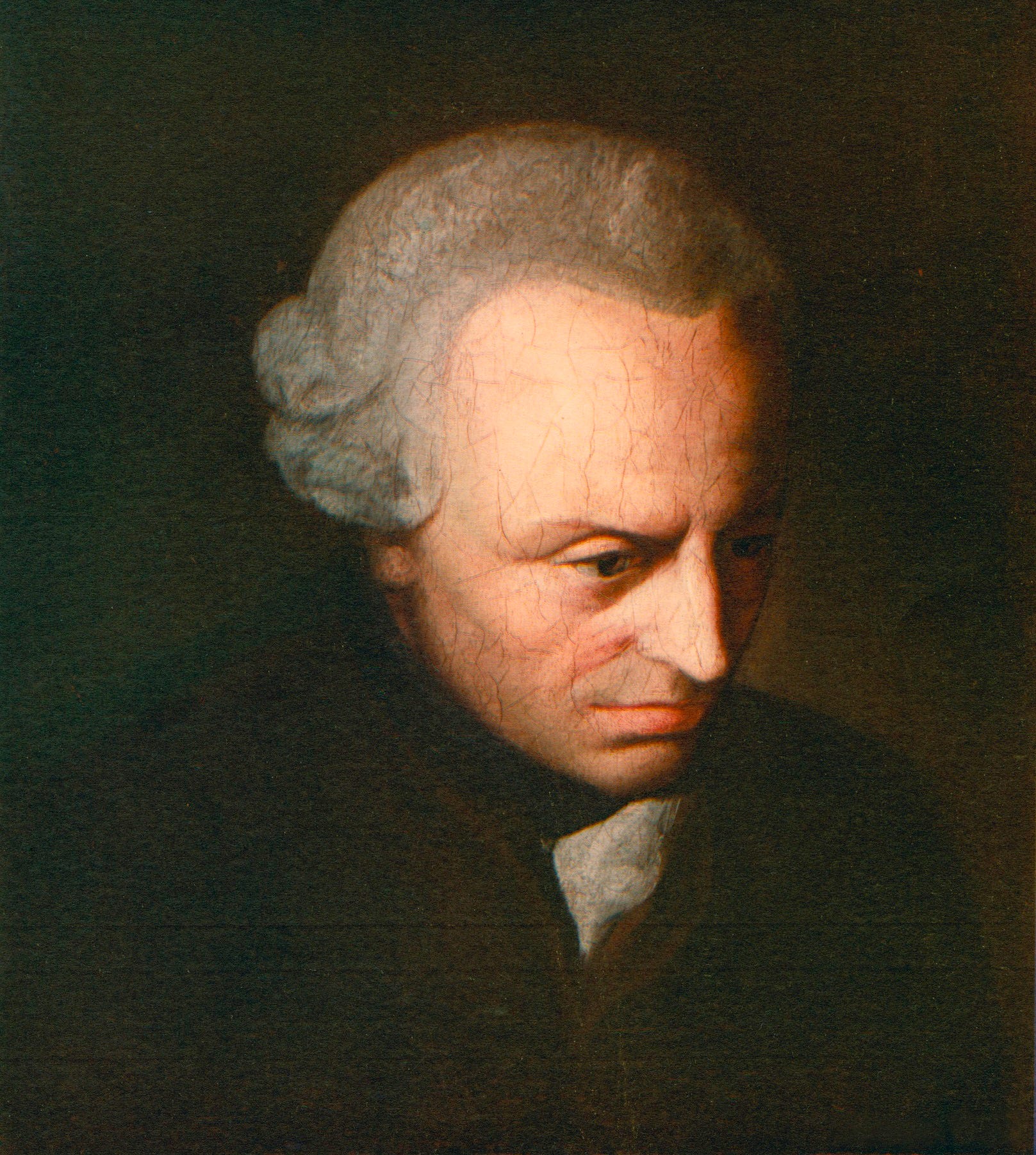
At once, Immanuel Kant the Judgmental (whom Machiavelli had cleverly selected as his defense) rose to object:
“Hobbes,” he said, “you have done the very thing you condemn. You have taken from Niccolò without his consent. If taking without consent is wrong, then by universal law you stand equal with him.
For that reason, though I oppose his actions, I must defend him: both of you are in violation of the moral law, yet only he is punished.”
Hobbes answered:
“You reason as though nothing had changed. But Niccolò has altered the moral context of the situation. Before his act, all could keep what was theirs without interference. That condition no longer holds. Someone must now bear the loss—either Locke, who was wronged, or Niccolò, who committed the wrong in the first place!
How is it fair to punish the innocent?!”
“That does not answer me,” said Kant. “A wrong is a wrong. If the universal principle is that no one’s goods should be taken without consent, then both acts violate it. And who is to decide what counts as restoration? Many tyrannies begin with just such claims.
By what principle do you claim the authority to override Niccolò’s autonomy, even in the name of restoration?”
Hobbes replied:
“You mistake a principle fit for a peaceful order for a rule fit for repairing its breach. The prohibition on taking without consent governs what we ought to do when no wrong has been done. But once Niccolò has taken, we are no longer in that condition.
We must decide where the loss shall fall. To leave things as they are is not neutrality—it is to assign the loss to Locke. To take from Niccolò is to return the loss to its source.”
The villagers murmured, for the matter had grown subtle.
“What happened next? Who was judged to be in the right?” The second friend asked.
The first friend answered:
“At this point, Aristotle the Prudent, who had heretofore remained silent, stepped forward to judge the case.
‘Both of you speak to something true,’ he said. ‘But neither has yet said what is most needed.
In an undisturbed world, the rule against taking without consent is sufficient for moral action. But Niccolò’s act has placed us outside that world. We must now judge what is fitting under conditions already broken.
If we refuse to act, we do not preserve justice—we abandon it. We leave Locke to bear a loss he did not choose, and in doing so we quietly punish him for another man’s wrongdoing.
The difference, then, is not between taking and not taking, but between taking that originates injustice and taking that restores order.
Hobbes, in this case, does not act as Niccolò does. One breaches the peace and creates imbalance; the other seeks to restore it.
Provided Hobbes takes only what is required to restore that balance—not too much and not too little—to treat his action and Niccolò’s as the same is to ignore the difference between causing harm and correcting it.’”
Kant the Judgmental, hearing this, fell silent.
And so the village came to understand that principles must be applied with attention to circumstance, and that a rule sufficient for peace is not always sufficient for repairing its breach.
Moral: When all cannot be preserved, the safety of the innocent is to be preferred.
“It turns out,” the second friend said, after a moment’s silence, “I hate your fables. Can you just articulate it logically like a normal person?”
“Very well,” the first friend replied…
Introduction
Part I of this series argued that moral reasoning must be responsive to constraint. By distinguishing between what is possible in principle (Can₁) and what is feasible in practice (Can₂), it showed that agents are sometimes required to choose the lesser of two evils when ideal options are unavailable. The central error—toxic idealism—arises when agents attempt to choose what cannot, in fact, be chosen, thereby producing worse outcomes.
Part II refines this error by focusing on a deeper confusion: the conflation of wish and choice. We may wish for ideal outcomes—universal peace, no loss, no harm—but wishing does not expand what is actually possible. When constraints bind, the object of choice is not the ideal, but the best option remaining within a diminished field. This distinction extends the framework from individual dilemmas to collective moral ecosystems. Entire doctrines can fail by treating infeasible ideals as actionable.
A moral principle, we shall argue, is adequate if and only if it satisfies two conditions:
(1) it is universalizable (Can₁-consistent), and
(2) it is collectively stable (Can₂-viable).
Accordingly, Part II develops four claims. First, moral reasoning must systematically distinguish wish from choice. Second, failure to do so produces toxic idealism and toxic pragmatism. Third, these pathologies apply to collective moral action, not just individual ethical choice. Fourth, navigating this distinction requires not just principles but virtue—the capacities to perceive goods, recognize constraints, and act under pressure. Where Part I established the logic of constrained choice, Part II extends it to the stability of moral reasoning itself.
I. Wish Versus Choice: The Conflation Problem
A critical error in moral reasoning involves conflating wish with choice. We might wish for ideal outcomes—that all lives be saved, that no goods need be jettisoned. But wishing does not make it so. As Aristotle distinguishes, wish relates to the end, while choice relates to the means.1 When ideal options are genuinely impossible given contextual constraints, we must choose among the options actually available. Attempting to choose the impossible option often reroutes to the worse of two evils, defeating the purpose of choosing the wished-for option in the first place.
This does not mean abandoning moral ideals. In unconstrained contexts, we should absolutely insist on ideal options. The moral prohibition against killing remains valid and vital. But when constraints make ideals impossible, clinging to them becomes toxic idealism—an insistence on impossible goods that paradoxically leads to greater evils.
II. Toxic Idealism: The Pacifism Problem
To understand toxic idealism more concretely, consider pacifism in political life. Pacifism represents a beautiful ideal: if everyone cooperates peacefully, violence disappears. In an ideal world where all always choose cooperation, pacifism would be morally perfect.
But Robert Axelrod’s work on the evolution of cooperation reveals a deep structural vulnerability in pacifism.2 In iterated prisoner’s dilemma tournaments, unconditional cooperators are quickly exploited by defectors. Once even a small number of aggressive defectors enter a pacifist population, they proliferate, ultimately destroying the cooperative equilibrium. The concept of evolutionarily stable strategies (ESS), developed by Maynard Smith and Price, explains why: pacifism fails the ESS test because it offers no mechanism to resist invasion by defectors.3

This reveals pacifism as toxic idealism. By insisting on an ideal (universal cooperation) that cannot survive minimally adversarial conditions, pacifists inadvertently enable the worst outcome (universal conflict). Attempting to choose the impossible good reroutes to the greater evil, because game-theoretic pacifism is not stable under such conditions.
The toxic idealism in the pacifism case differs in kind from that identified in the storm case. Pacifism is not a viable option under minimally adversarial conditions, and such conditions are inherent to the moral environment and to human nature. The storm, by contrast, is not inherent in the environment. We may therefore call the storm case “toxic idealism per accidens,” and the pacifism case “toxic idealism per se.”
III. Tit-for-Tat: The Superior Alternative
Contrast pacifism with tit-for-tat reciprocity: cooperate initially, then retaliate against defection. In Axelrod’s tournaments, tit-for-tat consistently outperformed both pacifism and aggressive defection. Tit-for-tat is what we might call “conditionally ideal.” In a world of cooperators, it behaves identically to pacifism. But when confronted with defection, it retaliates, making exploitation costly. This limited retaliation—the lesser evil—prevents collapse into universal conflict while maintaining cooperation wherever possible.
Crucially, tit-for-tat is collectively stable. As Boyd and Lorberbaum demonstrate, while no pure strategy is evolutionarily stable in the repeated prisoner’s dilemma, tit-for-tat can resist invasion by other strategies when played by a sufficient portion of the population.4 The crucial insight: tit-for-tat is superior to pacifism in both ideal and non-ideal conditions. In ideal conditions, tit-for-tat equals pacifism. In non-ideal conditions, tit-for-tat maintains stable cooperation while pacifism collapses. This gives tit-for-tat a strong prima facie claim to superiority as a moral-political strategy.
IV. Modal Synthesis: The Can₁/Can₂ Framework
To clarify these distinctions, we introduce a conceptual framework drawing on the scholastic distinction between potentia absoluta and potentia ordinata:5
Can₁ = possible per se, in principle, given only necessary (logical) constraints.
Can₂ = possible per accidens, in practice, given both necessary and contingent (contextual) constraints.
This distinction has immediate practical utility. The ship in the storm: it is Can₁ not to throw goods overboard—there is no logical contradiction. But given the storm, it is not Can₂. The trolley problem: it is Can₁ not to pull the lever, but given the villain’s constraint, saving all five is not Can₂. Choice-worthy action must be evaluated within Can₂ constraints, not only by Can₁ fantasies.
To quote Kant—to some extent against himself: “Ethics…must consider the conditions under which what ought to happen frequently does not” (4:398).
In our terms: moral reasoning must track constraint-sensitive feasibility (Can₂), not just logical possibility (Can₁).
Universal pacifism is Can₁—logically possible. But it is not Can₂—game-theoretic analysis gives strong reason to believe it cannot persist under adversarial conditions. Tit-for-tat, by contrast, is both Can₁ and Can₂. This illuminates the relationship between morality and choice-worthiness: morality traditionally operates with Should + Can₁, while choice-worthiness necessarily operates with Should + Can₂. But properly understood, even morality requires Can₂ for action-guidance.
All Can₂ possibilities are also Can₁, but not vice versa. This asymmetry explains why, if one were to boil ethics down to a maxim, one should choose in any given situation what is least bad, rather than what is most moral, because the moral may not be possible, and what is not possible cannot be the object of choice.
However, what is immediately choiceworthy may not always be ultimately so. If we are constrained to choose something good only kata kairon (in the moment), it is all too easy to forget that, if situations change, we ought to choose differently. Ideal morality must remain in view as a final end—logically possible though not always immediately realizable.
The Parallel Must₁/Must₂ Framework
Using this distinction, we may also distinguish between two forms of modal necessity, and clarify our prior answer to the trolley problem. Any harmful outcome stands in one of two modal relations to the action that produces it:
Must₁ (per se necessity): the harm is required by the plan itself. Without it, the plan fails in every possible world.
Must₂ (per accidens necessity): the harm arises from the situation but is not required by the internal structure of the plan. The plan could succeed without the harm in some possible world.
This modal distinction captures, in a more precise form, the intuitive difference between redirection and instrumentalization, seen in the difference between the trolley case and the doctor case: there exists a possible world in which the trolley operator’s plan does not have to kill anyone, but there does not exist a possible world in which the doctor’s plan is harmless.
The surgeon’s plan in the relevant case necessarily involves taking someone’s vital organs (which they need to live) without their consent, which is wrong. By contrast, the one tied to the tracks in the trolley problem is not functionally necessary for the trolley operator’s plan to divert the trolley (the one dies as a side consequence).
Harm, therefore, on our account is impermissible when it is per se necessary (Must₁) to the agent’s plan: i.e., when the plan functionally depends on the violation of a person. This echoes the Kantian imperative to “so act that you use humanity, whether in your own person or in the person of any other, always at the same time as an end, never merely as a means.”6
However, we contend that harm may be permissible when it is only per accidens necessary (Must₂): i.e., when it arises from an independently given constraint of the situation and is not structurally required by the plan itself. In such cases harm is only permissible if it also minimizes harm in reasonable expectation.
V. Toxic Pragmatism: The Mirror Error
If toxic idealism clings to impossible goods, its mirror image—toxic pragmatism—clings to constraints that no longer bind, forcing suboptimal or even immoral choices when better alternatives have become available.
This is precisely what happens in the second half of the fable. The foolish, drunken captain imagines a storm when the waters are calm. In his panic he rushes to cast the merchant’s cargo overboard—choosing what would be the lesser evil in a constrained situation, but which is simply evil when no constraint actually exists. The merchant, now wiser, recognizes the error: “You pretend constraint where none exists, and in so doing you wrong me.”
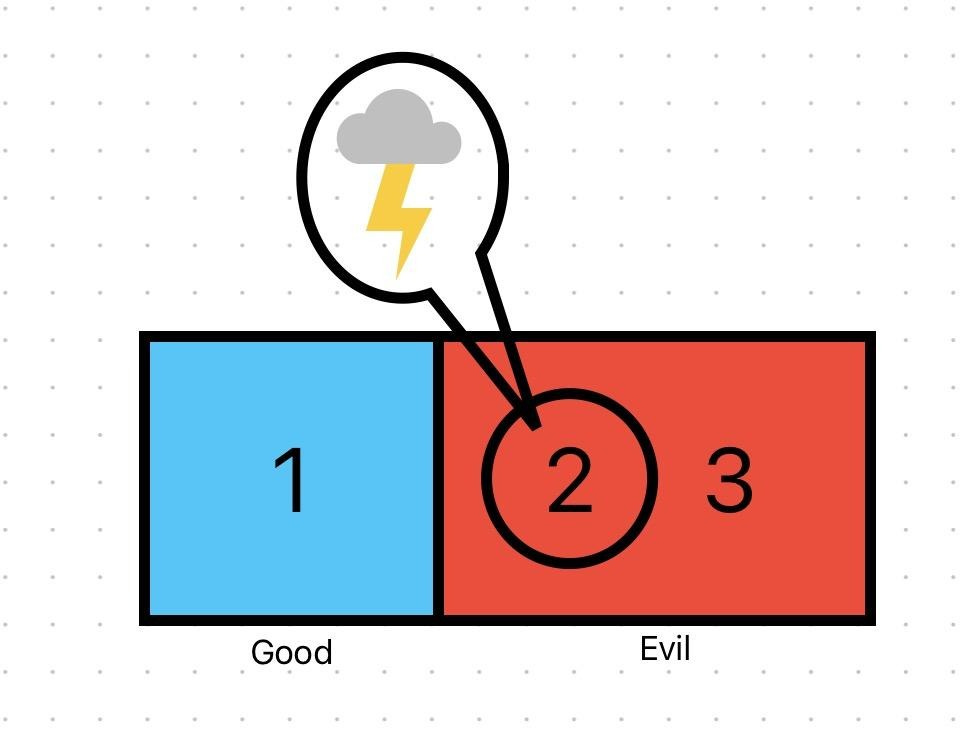
When the toxic pragmatist falsely imagines a constraint that is not present, we call this “toxic pragmatism per se.” When the toxic pragmatist correctly acknowledges that a constraint is present but erroneously asserts it to be per se rather than per accidens—permanent rather than temporary—we call this “toxic pragmatism per accidens.”
Hence there is a four-fold error taxonomy. Toxic idealism per se irrationally insists on options that are never available (universal pacifism). Toxic idealism per accidens irrationally denies that present constraints are real (the merchant in the storm). Toxic pragmatism per se irrationally insists that constraints are present when they are not (the drunken captain). Toxic pragmatism per accidens irrationally insists that temporary constraints are permanent.
VI. Epistemic Uncertainty and Rational Expectation of Constraint
A natural objection arises: the framework as stated assumes that the agent knows whether a constraint obtains. But real moral situations are rarely so transparent. How does the pragmatic idealist reason under uncertainty?
The answer is that constrained choice does not require certainty that Can₂ constraints obtain—only rational expectation, that is, justified belief proportioned to the available evidence. The wise captain does not need metaphysical proof that the storm will sink the ship. He needs seamanship—the experience-trained perceptual judgment that recognizes a genuine threat and distinguishes it from passing turbulence. His judgment is defeasible, but rational, and sufficient to ground action.
This rational expectation is precisely the work of phronesis. If phronesis is the accurate perception of contingent constraints as they bear on the present situation, then it necessarily operates under conditions of incomplete information. The person of practical wisdom is not omniscient but calibrated: their constraint-perception is trained by experience and unclouded by the distorting pressures of fear and wishful thinking—the twin sources of toxic pragmatism and toxic idealism respectively. The drunken captain’s error is not that he acted under uncertainty but that his belief was irrational: driven by fear rather than by evidence.
Rational expectation of constraint entails a revisability condition. Because the agent acts on justified belief rather than certainty, the agent remains obligated to update their assessment as evidence changes. This provides the structural explanation of toxic pragmatism per accidens: the agent whose initial constraint-assessment was rational but who fails to revise when conditions change, treating a temporary necessity as a permanent one.
VII. Historical Precedents and Critique
The structure identified here is not entirely novel. It appears, in a less formalized form, in early modern political thought. Hobbes, in effect, anticipates the Can₂ constraint: in the absence of enforcement, cooperative norms are strategically unstable, and agents are rationally driven toward defection. The state of nature is precisely the condition in which Can₁ moral ideals—such as keeping covenants—fail to be Can₂ feasible.
Machiavelli, from a different angle, criticizes the complementary error. Those who act according to how men ought to behave, rather than how they in fact do behave, “come to ruin.” This is an early diagnosis of what we have called toxic idealism: the failure to register binding constraints imposed by non-ideal conditions.
Yet both Hobbesian and Machiavellian realism risk collapsing into the opposite error. By emphasizing constraint without preserving orientation toward ideal goods, they incline toward what we have called toxic pragmatism. The present framework may thus be understood as a synthesis: preserving the realist insight that moral action must track feasibility (Can₂), while retaining the idealist commitment to universal moral structure (Can₁).
VIII. Critique and Extension of Kant
Kant’s Strength: Universal Structure
A Kantian might object to this entire framework. Kant provides two fundamental criteria for moral action in the Groundwork for the Metaphysics of Morals.
First, the principle of universalizability:
“Act only according to that maxim whereby you can at the same time will that it should become a universal law” (Kant 1785, 4:421).
Second, the principle that ought implies can:
“duty commands nothing but what we can do” (Kant 1788, 5:30).
It should be emphasized that the Kantian contribution here is substantial and (on our view) largely correct. Kant’s universalizability criterion captures something genuinely important: that moral principles must be coherent when generalized, that they cannot depend on special self-interested exemptions or private privileges. The Formula of Humanity—that persons must never be treated as mere means—expresses a deep structural truth about moral agency.
Kant’s Failure: The Missing Feasibility Constraint
These two criteria—universalizability and possibility—are meant to work in harmony. But Kant, we contend, crucially fails to fully specify what “possibility” means, and this underspecification creates a fundamental tension in his whole moral system.
Consider the choice between pacifism and tit-for-tat reciprocity. Both are universalizable in Kant’s formal sense: we can coherently will that everyone adopt either strategy without logical contradiction. A world where everyone is a pacifist contains no formal impossibility: Pacifism is possible under ideal conditions.
But here the problem emerges. While pacifism is formally universalizable under ideal conditions (Can₁), it is not strategically viable under the slightest nonideal conditions (Can₂). Game-theoretic analysis proves that pacifism, when universalized, predictably and inevitably collapses into tyranny. Importantly, this is not merely an empirical observation but a structural feature demonstrable through a priori reasoning: to will pacifism is to indirectly but predictably will tyranny—the very opposite of the peaceful end state the pacifist envisions.
This reveals what we might call a “practical contradiction” distinct from Kant’s “contradiction in conception” and “contradiction in will.” This sort of practical contradiction occurs when a maxim, though logically coherent, predictably generates dynamics that defeat its own operative ends when universally implemented. This is not mere bad consequence but structural self-frustration, often identifiable a priori.
Kant’s famous absolute prohibition on lying faces the same structural problem. In On a Supposed Right to Lie from Philanthropic Concerns (1797), he insists that one must tell the truth even to a murderer asking about their intended victim’s whereabouts. But this extreme position fails to take into account lesser-of-two-evils situations where some violation of rights appear to be tragically unavoidable.
As Benjamin Constant (to whom Kant is responding) asserts:
“It is a duty to tell the truth. The notion of duty is inseparable from the notion of right. A duty is what in one being corresponds to the right of another. Where there are no rights, there are no duties. To tell the truth then is a duty, but only towards him who has a right to the truth. But no man has a right to a truth that injures others.”
The murderer puts us in a bind wherein someone’s right is inevitably going to be violated. For we will either have to lie to the murderer or break our promise to hide our friend. And as John Locke memorably puts it, “when all cannot be preserved, the safety of the innocent is to be preferred” (Second Treatise, §16). In tragic conflicts, someone’s right must be violated. The only real choice in murderer-at-the-door is whether to violate the offender’s right or the victim’s. Kant in this case chooses to violate the victim’s, which we claim is immoral.
The root issue is that Kant conflates two distinct senses of possibility: logical possibility (the absence of formal contradiction—Can₁) and strategic possibility (the capacity to persist when implemented—Can₂). By focusing exclusively on logical possibility, Kant systematically endorses strategies that are collectively unstable—strategies that, like pacifism, seem moral in isolation but enable evil when practiced.
The New Criterion: Practical Coherence and Collective Stability
Moral principles, therefore, must be not possible in the sense of formal universalizability but also in terms of collective stability. We cannot make do only with Kantian Idealism, or Hobbesian Realism, rather we must synthesize them into a “realist idealism and idealist realism,” wherein we commit to choosing the best (or least bad) available option within real constraints, always aiming to actually realize, as our end goal, Kant’s kingdom of ends on a Hobbesian earth.
Both the criteria that Kant himself endorses—universalizability and possibility—must be satisfied. But possibility must be understood in two ways: both as Can₂ (practical feasibility), and not merely Can₁ (logical coherence). A moral system that ignores this distinction will, like Kant’s, repeatedly endorse beautiful ideals that reroute to their own strategically incoherent negation.
It should be emphasized that the view stated above is not consequentialist in any naive sense. Although Kant’s overly idealistic moral framework will lead to tragic and deplorable consequences, the problem is more, in our view, the strategic incoherence of Kant’s toxically ideal moral will.
A will implicitly aims to realize that which it chooses, otherwise it would be indistinct from a wish. However, the will which ignores constraining context—that which is possible per se but impossible per accidens—would be trying to will the realization of an end which, structurally, on account of non-ideal, but existent, contextual conditions, has been rendered impossible. And willing what we can know a priori to be strategically infeasible, to some extent contradicts the point of willing in the first place.
The Neo-Kantian Problem
Contemporary Kantians have not been entirely insensitive to this difficulty. Herman has argued that Kantian deliberation incorporates contextual sensitivity through “rules of moral salience.”7 Korsgaard grounds normativity in reflective endorsement, introducing agent-relative feasibility considerations.8 Wood reads Kant’s ethics as requiring empirical anthropology to bridge principle and practice.9 These represent genuine advances. However, none formally incorporates the critical missing criterion: collective stability.
Consider again the test case: pacifism versus tit-for-tat. Both pass Kant’s universalizability test. Both pass Herman’s test of moral salience. Both are reflectively endorsable in Korsgaard’s sense. Yet pacifism is collectively unstable while tit-for-tat is collectively stable. No existing neo-Kantian criterion formally distinguishes between them on these grounds. The Can₁/Can₂ framework identifies precisely this gap: the neo-Kantian enrichments address contextual sensitivity within deliberation but do not yet require that the universalized strategy be dynamically stable against defection.
What is required, then, is not the abandonment of Kantian universalizability but its supplementation with a feasibility criterion that tracks Can₂. And the faculty that perceives whether this latter condition obtains is not sophia but phronesis.
IX. The Imperative to Virtue
The framework of pragmatic idealism reveals why virtue ethics is not optional but necessary. We cannot know in advance what constraints we will face. Such constraints arise in time, in the moment, and are available only to an agent whose mind is contextually aware and able to adapt. This context-bounded uncertainty makes the development of moral virtues essential for right action, and resists the strict formulation of morality into a set of dogmas and rules.
As Aristotle argues, virtue is a state of character concerned with choice, lying in a mean relative to us, determined by the principle by which the person of practical wisdom would determine it.10 This definition takes on new significance in light of the Can₁/Can₂ framework. Three Aristotelian virtues map directly onto this structure: sophia (theoretical wisdom), phronesis (practical wisdom), and andreia (courage).
Sophia and Can₁: The Perception of Universals
Sophia—theoretical wisdom—is the cognitive capacity that apprehends what is universally and unconditionally true: the nature of the good, the structure of valid moral principles, the ends that are genuinely choice-worthy in themselves.11 In our framework, sophia corresponds to Can₁ cognition—the grasp of what is possible in principle and what is morally required under ideal conditions. It is sophia that perceives, for instance, that killing an innocent is wrong, that cooperation is better than conflict, that rights ought to be respected.
The Kantian contribution here is substantial and largely correct. Kant’s universalizability criterion captures something genuinely important. Sophia is precisely the faculty that apprehends such truths. Our critique of Kant is not a rejection of these insights but a claim that they are necessary and insufficient. This is the deep structure of the ancient disagreement between moral idealists and moral realists. Sophia without phronesis yields toxic idealism. Phronesis without sophia yields toxic pragmatism.
Phronesis and Can₂: The Perception of Constraints
Phronesis—practical wisdom—is the cognitive capacity that tracks what is feasible under actual, contingent, non-ideal conditions. As Aristotle notes, phronesis must recognize the particulars, for it is practical, and practice is concerned with particulars.12
In our framework, phronesis corresponds to Can₂ cognition: the accurate perception of which constraints genuinely bind the agent in the present moment. Constraints are contingent, particular, and variable—they arise and pass away in time, differ from situation to situation, and cannot be determined in advance by universal principles alone. Phronesis enables the agent to distinguish real storms from imagined ones (avoiding toxic pragmatism), recognize when constraints have lifted (avoiding toxic pragmatism per accidens), accept real constraints as binding (avoiding toxic idealism per accidens), and recognize structural impossibilities as permanent (avoiding toxic idealism per se).
The relationship between sophia and phronesis can now be stated precisely. Sophia provides the stable ordering of goods—the universal moral framework against which options are ranked. Phronesis determines which of those options remain live in the present context. Together, they constitute the full modal cognition required for constrained choice. As Aristotle observes, it is not possible to be good in the strict sense without practical wisdom, nor practically wise without moral virtue.13
Andreia: The Courage to Choose Rightly in Tragic Situations
But perceiving constraints and knowing goods are insufficient without the strength to act on this knowledge. In constrained choice situations, the agent must actively choose something recognized as genuinely evil in its local character—not evil on balance, but evil simpliciter insofar as it is considered apart from the constraining context.
This creates a distinctive psychological obstacle: moral paralysis—the inability to execute the choice-worthy action because executing it requires willing an evil, even a lesser one. The morally paralyzed agent sees the constrained landscape clearly, knows which option is least bad, but cannot bring themselves to act. They freeze at the lever.
In the framework of constrained choice, paralysis is not innocence. The agent who freezes at the lever does not thereby avoid moral involvement. Attempting to preserve the now-impossible ideal reroutes into the greater of two evils. Inaction is itself a choice, and in constrained contexts, it is the worst choice available.
Two reasons explain moral paralysis. The sympathetic reason is genuine moral horror. The person who recognizes that pulling the lever will cause a death is responding appropriately to a tragic situation. The error lies not in the recoil but in allowing the recoil to prevent action. As Bernard Williams argues, there is a form of agent-regret that is not only appropriate but morally required: the courageous agent pulls the lever while flinching—acting rightly while fully registering the moral cost.14 Andreia is not the absence of moral distress but the capacity to act rightly through it.
The less sympathetic reason is the desire for moral purity—the wish to keep one’s hands clean at the expense of others’ lives. The agent who refuses to pull the lever has prioritized their own moral comfort over the lives of four additional people. This is not humility before the moral law; it is a kind of moral self-indulgence.
The Interdependence of the Virtues
These three virtues are mutually constitutive, and their interdependence maps directly onto the error taxonomy. Sophia without phronesis and andreia produces the toxic idealist: the merchant who insists the captain save the cargo in the teeth of the storm. Phronesis without sophia and andreia produces the toxic pragmatist: the drunken captain—or, more dangerously, the Machiavellian operator who invokes “necessity” to justify what is merely convenient. Andreia without sophia and phronesis produces bold but misguided action.
Together, these three virtues constitute the pragmatic idealist character: the agent who is wise enough to maintain a stable ordering of genuine goods (sophia), perceptive enough to recognize which goods remain accessible under present constraints (phronesis), and strong enough to choose the best available option even when it involves moral cost (andreia). Aristotle’s claim for the unity of the virtues is not merely a philosophical thesis but a structural requirement of any agent who would navigate the space between toxic idealism and toxic pragmatism.
Conclusion: The Art of Choosing Goods in Season
The central claim of this paper is that moral action must be evaluated within a two-level modal framework: what is possible in principle (Can₁), and what is feasible under actual constraints (Can₂). Idealist theories capture the first but neglect the second; realist theories capture the second but neglect the first. A complete account of moral reasoning must integrate both.
Moral danger lies primarily not in contextual choice but in misperceiving context. Toxic idealism insists on impossible goods, thereby ensuring collapse into greater evils. Toxic pragmatism insists on obsolete constraints, thereby choosing inferior options when better ones are available. The longstanding opposition between moral idealism and political realism is thus revealed as a false dichotomy. The distinction between Can₁ and Can₂ allows us to see both as partial truths and to synthesize them into a single framework: Pragmatic Idealism.
This is not merely an intellectual framework—it requires the development of moral and modal cognition. We need phronesis to perceive actual constraints, sophia to know genuine goods, and andreia to choose rightly even in tragic circumstances. Aristotle’s concept of kata kairon—according to the moment—reminds us that ethics is neither blind adherence to principle nor pure calculation of utility. It is the art of choosing goods in season.
The moral of our fable bears repeating: It is as great an error to invent necessity where there is none as to deny it where it presses upon us. Always attend to the context, and choose your captains well.
The moral life requires both the aspiration to ideals and the wisdom to recognize when circumstances constrain our choices. We must resist both the fantasy of ideals that cannot withstand the storm and the delusion of storms that have already passed. Only through pragmatic idealism-maintaining our orientation toward the good while accurately perceiving our context—can we choose what is truly choice-worthy in the moment while maintaining our moral compass for the journey ahead.
Through pragmatic idealism, grounded in the cultivation of virtue, we learn to choose not just the good, but the available good-and to work toward making more goods available. Pragmatic idealism does not abandon the good but refuses to idolize the impossible. It calls us to cultivate the virtues that allow us to see storms clearly, to steer between Scylla and Charybdis, and, when seas are calm, to set sail toward the highest goods attainable by us.
Cole Whetstone did his undergraduate work in Classics at Harvard University and received an MSt in Ancient Philosophy at the University of Oxford. He taught Ancient Greek at Oxford and co-founded Oxford Latinitas, a society of Oxford academics dedicated to reviving Latin and Greek in scholarly use. He now lives in New York City, where he is a co-organizer for the New York Philosophy Club.
Aristotle, Nicomachean Ethics 1111b26–27.
Robert Axelrod, The Evolution of Cooperation (New York: Basic Books, 1984).
John Maynard Smith and George R. Price, “The Logic of Animal Conflict,” Nature 246 (1973): 15–18.
Boyd and Lorberbaum, “No Pure Strategy is Evolutionarily Stable in the Repeated Prisoner’s Dilemma,” Nature 327 (1987): 58–59.
See William J. Courtenay, Capacity and Volition (Bergamo: Pierluigi Lubrina, 1990).
Kant, Groundwork, 4:429.
Barbara Herman, The Practice of Moral Judgment (Cambridge, MA: Harvard University Press, 1993).
Christine Korsgaard, The Sources of Normativity (Cambridge: Cambridge University Press, 1996).
Allen Wood, Kantian Ethics (Cambridge: Cambridge University Press, 2008).
Aristotle, NE 1106b36–1107a2.
Aristotle, NE 1141b2–3.
Aristotle, NE 1141b14–16.
Aristotle, NE 1144b30–32.
Bernard Williams, “Moral Luck,” in Moral Luck (Cambridge: Cambridge University Press, 1981).