



Editorial note: this article by Cole Whetstone is the first of two installments. The second may be read here.
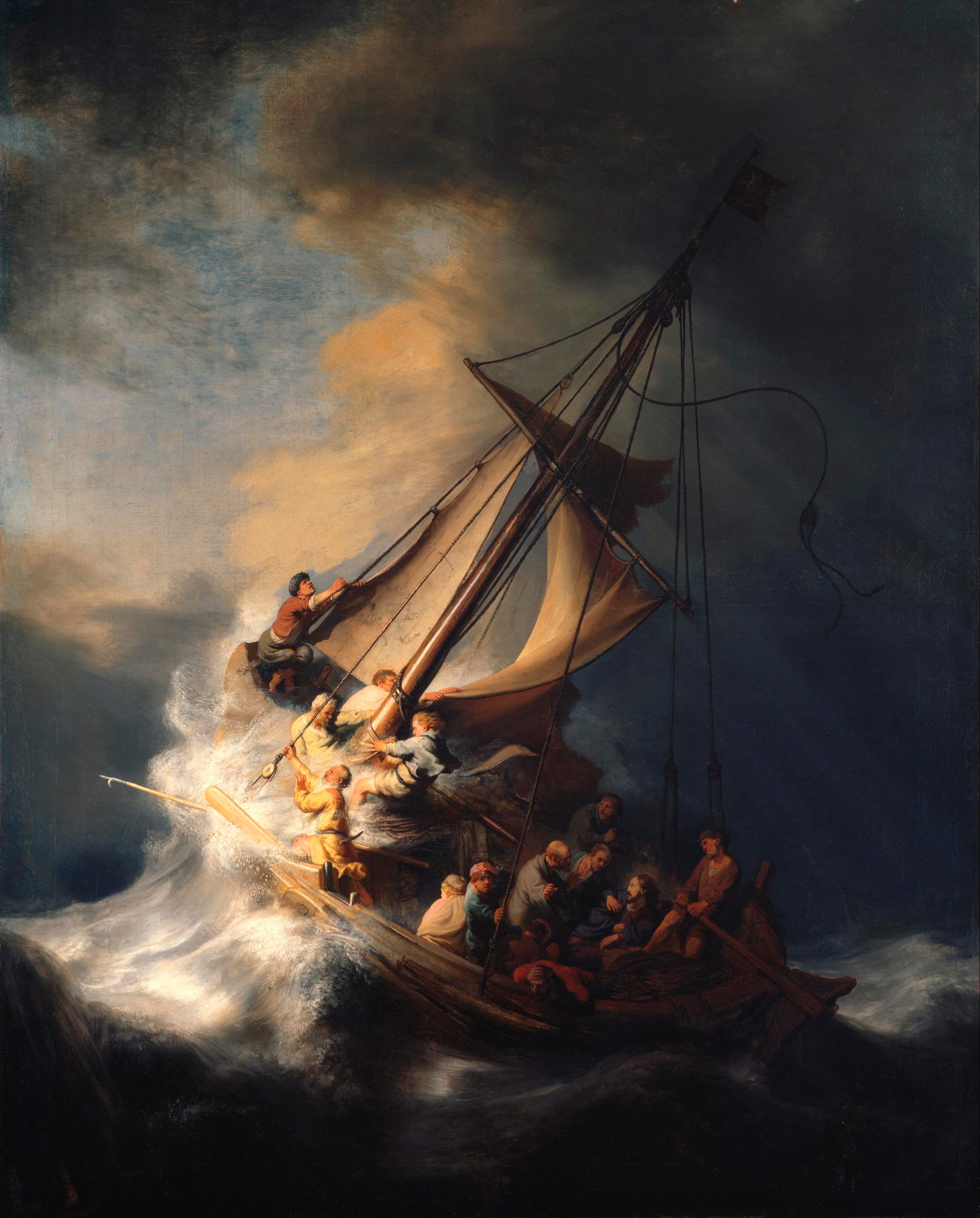
Two friends were quarreling about politics. The first, seeking to prove his point, told this story:
“A young merchant once set sail with a wise old captain, his goods stored below. But when a storm struck, the captain judged that the only way to save the ship was to throw the cargo into the sea. The merchant cried out, ‘You are stealing what is mine!’ But the wise old captain replied, ‘Your goods are already lost. If I try to preserve them, I will lose both them and the ship. You speak as if there were no storm constraining our choice, but wishing does not make options real. Since the storm has taken away the possibility of saving the goods, it would be foolish to try.’”
The second friend said, “I concede your point. It is a mistake to attempt the impossible: ‘should’ requires ‘can.’ But it seems you have not heard what happened to the very same merchant the very next day.”
The first asked, “And what happened to him?”
So the second told this story:
“...the storm passed, and though his original cargo was lost, the young merchant, hoping to recover his fortune, purchased new wares on debt at the next port. Still angry at the captain, the young merchant sought another ship to take him home and found one, this time piloted by a more foolish and cowardly man. When they set sail, he again stored his goods below.
But once they were on the sea, the foolish captain, having drunk too much, arose in fear, imagining a storm when the waters were calm. In his panic he rushed to cast the merchant’s cargo overboard.
The merchant, made wiser by experience, cried: ‘Stop, you foolish man! You are truly stealing from me now, for here there is no storm, no necessity constraining our choice. You pretend constraint where none exists, and in so doing you do me wrong!’”
Moral: it is as great an error to invent necessity where there is none as to deny it where it presses upon us. Always attend to the context, and choose your captains well.
I. Introduction
The Trolley Problem
Moral dilemmas often force us to confront the limits of principle. Few examples make this clearer than Philippa Foot’s trolley problem (Foot 1967). A runaway trolley hurtles down a track toward five tied-up workers. By pulling a lever, you can divert it onto another track, where one person is tied down. Should you pull the lever?
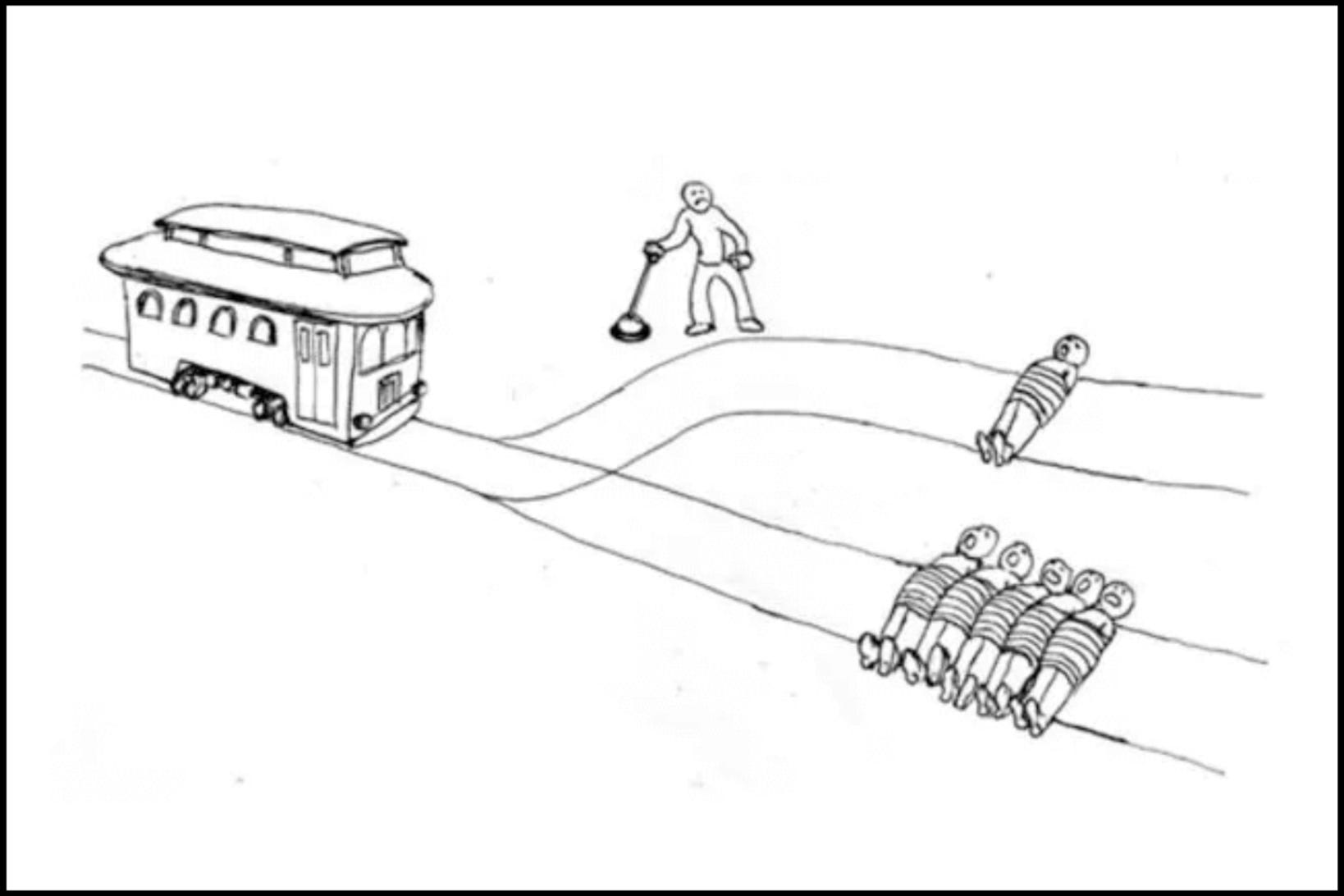
At first glance, this presents a clash of moral absolutes: the duty not to kill versus the imperative to save lives. The paradox seems intractable—without context, we should not pull the lever (we should not kill), but within context, we seemingly must (to save four net lives). This tension, I will argue, reveals something fundamental about the structure of moral choice under constraint.
The Nature of Moral Constraints
It should be noted that the problem addressed in this paper is not confined to particular dilemmas such as the trolley case, but reflects a deeper and longstanding tension in moral and political philosophy. On one side stand idealist frameworks—most prominently Kantian ethics—which articulate universal moral principles but often fail to account for the constraints imposed by non-ideal conditions. On the other side stand realist traditions, associated with Hobbes and Machiavelli, which take those constraints seriously but risk abandoning the structure of moral norms altogether.
This paper proposes a resolution to this tension. By distinguishing between what is possible in principle (Can₁) and what is feasible under actual conditions (Can₂), we can preserve the insights of both traditions while avoiding their characteristic errors. Idealism correctly identifies the structure of moral goods, but fails when it ignores feasibility. Realism correctly tracks feasibility, but fails when it loses orientation toward genuine goods. The framework developed here—what I will call pragmatic idealism—aims to synthesize these positions into a unified account of constrained moral choice.
II. Mixed Actions and the Storm at Sea
Aristotle’s account of “mixed actions” in Nicomachean Ethics Book III (1110a–1111b) provides our philosophical foundation to the solution of the paradox. Consider his example: sailors in a storm throwing cargo overboard to save their ship. Outside a storm, deliberately destroying someone’s goods is unjust—even criminal. Within the storm, however, the choice transforms. The sailors no longer choose between preserving and discarding goods. They choose between losing the cargo or losing both cargo and lives.
Aristotle calls such actions choice-worthy kata kairon—according to the moment, in context (NE 1110a5-10). They are voluntary in one sense (the sailors choose to throw the goods) but involuntary in another (they would never choose to do this absent the storm). As Aristotle notes, “such actions, then, are mixed, but are more like voluntary actions; for they are worthy of choice at the time when they are done” (NE 1110a11-12). The key insight: context can constrain our options such that what would normally be immoral becomes the most choice-worthy action available, because better options become temporarily impossible to actually choose.
This is not mere relativism. The storm creates what we might call a “constrained choice situation” where the ideal option—save both goods and lives—becomes circumstantially impossible. The actual choice is between two evils: lose the goods (lesser evil) or lose everything (greater evil). In such contexts, choosing the lesser evil is not just permissible but morally required. Moreover, and crucially, in this situation, if one attempts to choose the ideal option of saving both goods and lives, one will be effectively rerouted to the worse of two evils, losing both goods and lives. And this when it was really possible to save lives with courageous sacrifice of the goods.
III. The Structure of Constrained Choice
Let us formalize this structure. In any moral situation, we can identify a possibility space of options ranked by their choiceworthiness:
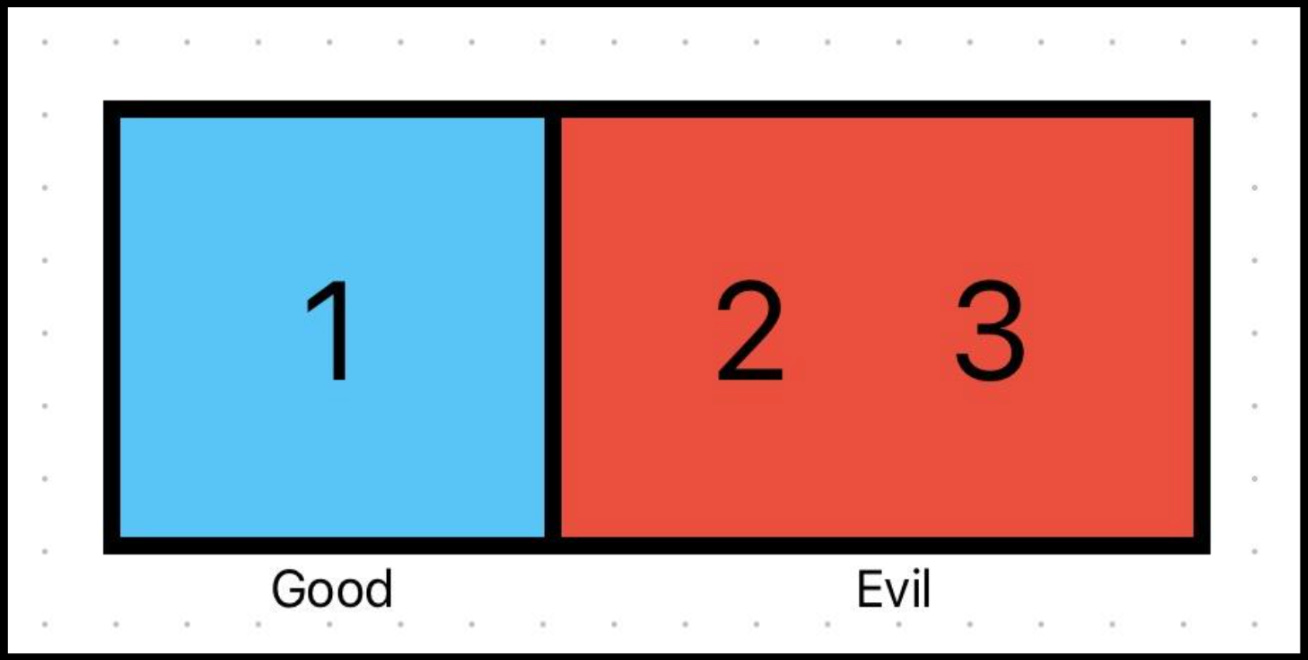
Diagram 1 represents the basic 3-option moral possibility space. A > B > C where > represents comparative choiceworthiness. Option 1 (labeled “Good”) represents what is choiceworthy in ideal conditions—choiceworthy unconditionally. Options 2 and 3 (labeled “Evil”) represent what is not choiceworthy in ideal conditions, but only conditionally choiceworthy when nonideal conditions prevent choosing the unconditionally good option.
In concrete terms:
Option 1 = the ideal option (save all lives, keep all goods);
Option 2 = the constrained good, or lesser evil (save some lives, jettison the cargo);
Option 3 = the ruinous option, or greater evil (lose all lives, lose all goods).
In ideal conditions, Option 1 is available and morally required. We must choose it. But what happens when a storm constrains our choices?
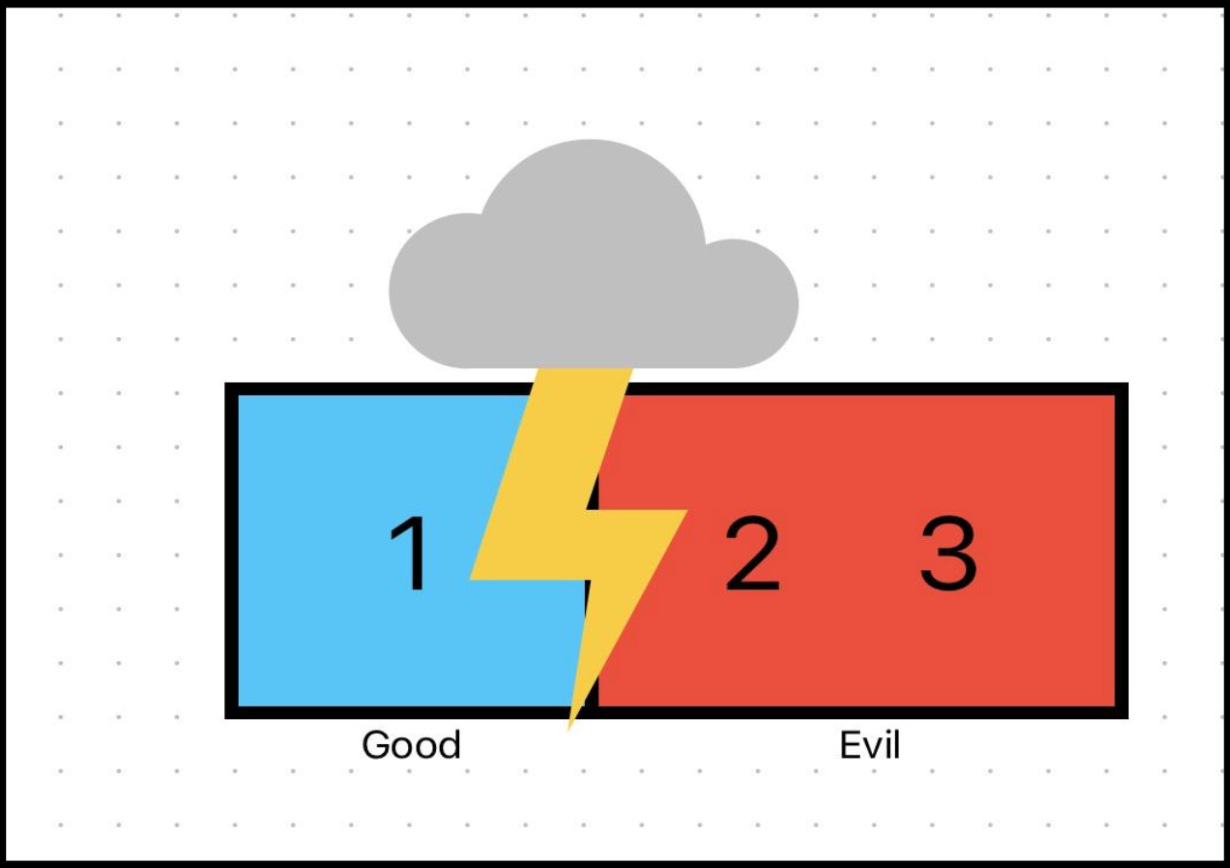
Diagram 2 represents how moral constraints per accidens (in this case a storm) prevent the agent from choosing the morally good option (1) and force them into a choice where they must select the lesser of two evils (either 2 or 3). But what happens when an agent, confronted with this constrained situation, nonetheless attempts to choose the now-impossible ideal?
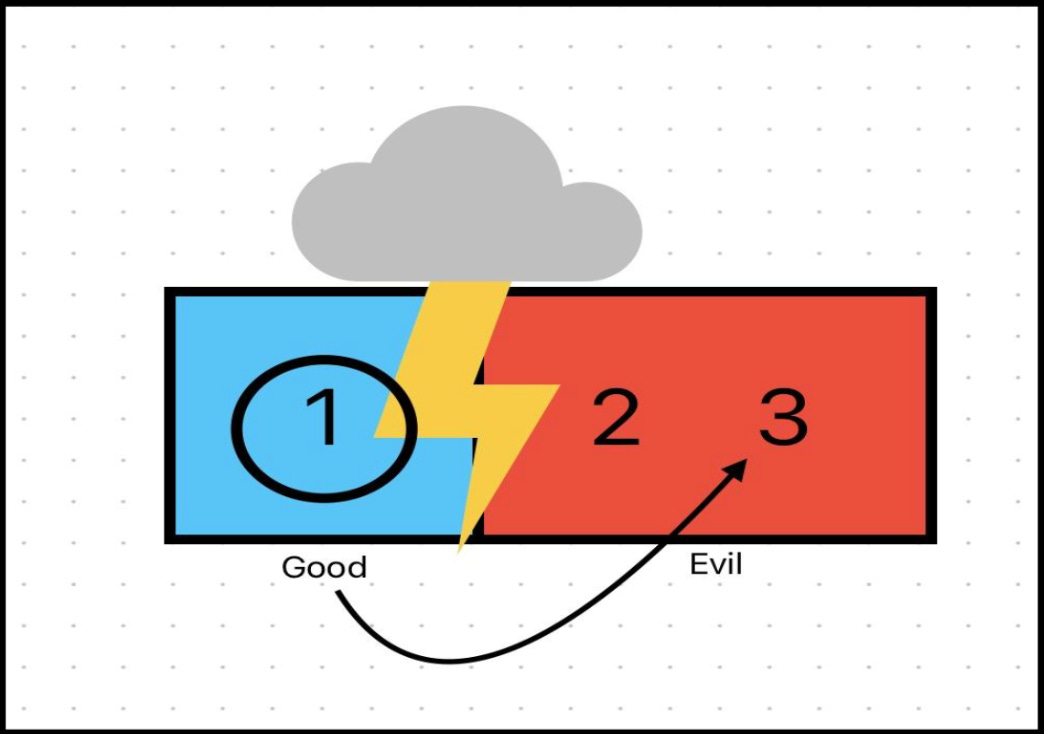
Diagram 3 represents toxic idealism: the error of attempting to choose an option that constraints have made impossible. Notwithstanding the moral constraint, the agent attempts to choose the ideal option (1) anyway. However, in this constrained case, attempting to choose the ideal option reroutes into the greater of two evils (3). Hence the toxic idealist chooses the impossible good and gets the greater of two evils, even when the lesser evil (2) was available. Choosing a worse option than is available is definitionally irrational, and reveals the need for at least some pragmatism.
This is precisely what would happen to the merchant in our fable if he refused to let the wise captain jettison his cargo: by attempting to preserve goods that the storm has already made impossible to save, he would lose both the goods and the ship.
IV. Applying the Framework to the Trolley Problem
The trolley problem maps directly onto this structure. As Thomson (1985) elaborates in her development of Foot’s original case, the villain who tied people to the tracks has created a storm-like constraint: someone will die regardless of our choice.
Our solution to this problem is parallel to our solution in the goods-on-a-ship case. In that case, the sailors must accept either that the goods must be thrown overboard or that the goods will go down with the ship. Hence in every case treating “save the goods” as a live option is unrealistic: the goods are lost in either case, and should not enter as a relevant factor in deliberation given the sure existence of the constraining context (the storm). Hence, the decision simplifies:
Either save the ship (and lose the goods)
Or lose the ship (and lose the goods).
Once the tragic reality of the situation is accepted, the solution to the problem is trivial.
Likewise, in the trolley problem, in either real case, someone will die. It would be nice if this were not the case, and not all cases are constrained in the way the trolley problem is. In such unconstrained cases, to kill an innocent person would be wrong. But in this case, ex hypothesi, the death of at least one is inevitable.1 The villain, in his villainy, has tragically made it so that someone’s life is inevitably forfeit. To pretend otherwise is to fail to appreciate the tragic reality of the situation.
Once we accept this constraint, we can reframe the decision: we cannot save everybody, but we may still choose to minimize harm. Crucially, this is importantly asymmetric from choosing to kill one person rather than five. For in our case, one death is, tragically, inevitable—imposed by the villain’s prior immoral action. Acknowledging this tragic inevitability, our actual choice is:
save no additional lives (do nothing)
or save some additional lives (pull the lever).
Within this constrained context, pulling the lever becomes choice-worthy kata kairon. It remains tragic—we must do something that, absent the constraint, would be murder. But given the constraint, it becomes the most choice-worthy action available.
V. The Surgeon Problem
One might attempt to collapse the distinction developed above by modifying Foot’s familiar organ harvesting case. Suppose the five dying patients are not victims of natural organ failure, but have instead been intentionally poisoned by a malicious actor. The constraint is now fully external—a “storm” not of the surgeon’s making. The case is thereby brought structurally closer to the trolley problem: a villain has imposed a condition in which multiple deaths are imminent unless some intervention occurs.
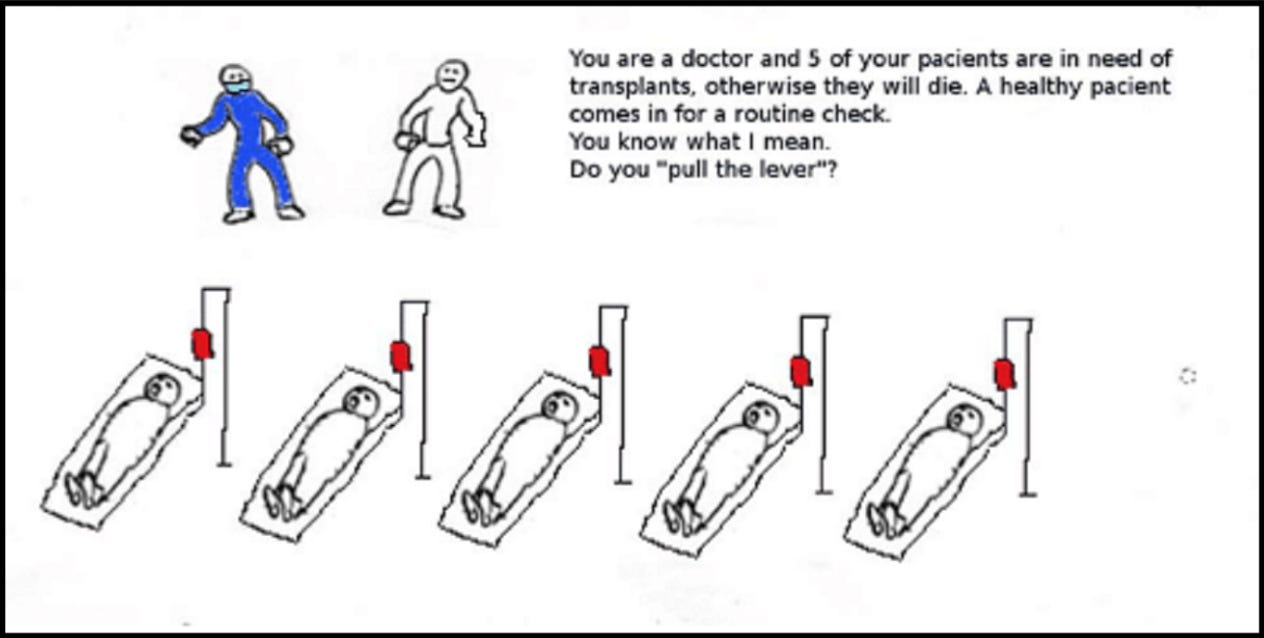
Does this transformation now license the surgeon to harvest the organs of one healthy patient to save the five?
Intuitively, it does not. The appeal to lesser-evil reasoning—even when supplemented by a constraint-sensitive principle such as Can₂ (practical feasibility under constraint)—does not yield a general permission to minimize harm by any available means. To see why, we must introduce a structural boundary between (A) redirecting an existing threat with the aim of minimizing harm, and (B) instrumentalizing an independent agent.2 This boundary echoes both Kant’s Formula of Humanity and the traditional Doctrine of Double Effect, but it can be stated more precisely in terms of constraint and feasibility.
Two Kinds of Constraint
We begin by distinguishing two fundamentally different sources of limitation:
Natural constraints are not produced by limited agents. These include storms, disease, scarcity, and other features of the world that delimit what is possible without anyone’s choosing them. Natural Constraints “just are,” and as such should be recognized, and taken into account during deliberation without moral condemnation, as this judgement would be entirely ineffective.
Artificial constraints are produced by limited agents. These include coercion, violence, deception, or any act that restricts another’s range of action. Artificial constraints, are subject to moral evaluation, and often to condemnation, because they unduly or unfairly limit the agency of another.
Pragmatic Idealism builds on this taxonomy through a commitment to what we may call Constraint Realism (CR):
Agents must deliberate within the feasible set defined by the actual constraint landscape, not an idealized or counterfactual one.
As such, “ought” is indexed to the feasible ideal, not merely to the imagined or theoretically perfect ideal. In the storm case, one cannot save both ship and cargo. The storm has removed that possibility from the space of available options. To deliberate as though it remained available is therefore to abandon fidelity to the real constraints of the situation.
That said, realism about constraints does not license their arbitrary creation, even to “solve” moral problems. The villain who ties innocent victims to the Trolley tracks, or poisons innocent patients, is ex hypothesi villainous.
A second principle is therefore required, the Principle of Non-Manufacture (PNM):
It is impermissible to introduce, or “manufacture” new constraints on others’ agency (or rights) that are not already present in the situation.
The impropriety of manufacturing constraint can be grounded in at least three ways.
Such constraint-creation constitutes a violation of rights, or more precisely, a violation of equitable regard of moral agency as such. In Kantian terms, it treats persons merely as means, subordinating one agent arbitrarily to the external ends of another, and so is intrinsically unjust. It is, further, self-defeating under recursive evaluation: a world in which such constraint-creation is permitted undermines the very conditions of agency it presupposes. All cases point to a fundamental asymmetry in one agent’s treatment of another -- a failure to regard agents as equal in basic dignity and therefore necessarily equitable in status. Thus, while constraints must be accepted once they exist, they must not be manufactured.
There is thus a temporal asymmetry, particularly at play in cases of villainy.
ex ante (before the fact), one ought not create unjust constraints; villainy is impermissible by PNM, and should be opposed.
ex post (after the fact), we must respond appropriately to the constraints that have already been created, whether naturally or artificially.
This introduces a key insight in cases of artificial villainy: we condemn the introduction of the constraint, but must still deliberate within its consequences. This is a limited kind of “acceptance” required for proper action, and is, we contend, a confounding factor in attempted solutions to the Trolley Problem.
For while we are claiming that a limited kind of acceptance ex post is warranted in order to deliberate properly in the case of the trolley problem, we by no means mean that the villain’s actions should be accepted ex ante, as to do so would justify injustice, and violate PNM.
Two-Stage Structure of Deliberation
Pragmatic Idealism therefore proceeds in two stages.
Constraint Assessment: the agent identifies the actual constraint landscape, determines the feasible set of actions given those constraints, and accepts both natural constraints and already-imposed artificial constraints as delimiting the situation.
Moral Selection Under Constraint: the agent optimizes within the feasible set subject to PNM, excluding any action that would unduly introduce new constraints on others.
A crucial clarification follows from this two-stage structure. The fact that a constraint exists does not imply that it is justified. We may be required to act within a ex post constraint while simultaneously condemning its origin ex ante.“Should” implies “can,” but “can” alone cannot justify “should.”
In our box-diagrams, this simplifies into a single rule: choose the leftmost available option, or choose the best available option, where best is determined, more or less, by Kant’s Formula of Humanity. How pragmatic idealism differs from Kant’s philosophy or standard rights-based philosophy is that it is a realist about constraints without devolving into mere utilitarianism.
Application of Constraint-Based Reasoning
The contrast is clearest in two canonical cases. In the storm case, the loss of cargo is imposed by nature; the feasible set excludes saving both ship and goods. Throwing cargo overboard is therefore permissible, albeit only in this case, as it respects the structure of the situation. This is a simple case of Constraint Realism (CR).
In the villain case, the constraint is introduced by an agent (the villain), and its introduction is morally impermissible ex ante—but once imposed, agents must still deliberate ex post within its consequences. The origin of the constraint and its violation of PNM determines its moral status, but its presence dictates the structure of proper deliberation according to CR.
Applied to the surgeon and trolley cases, this framework clarifies their intuitive asymmetry. In the standard surgeon case, (A) 5 patients are constrained by disease, but (B) 1 is healthy; killing the healthy patient manufactures a new constraint on an otherwise unconstrained agent, violating the prohibition on manufacturing constraints (PNM).
In the trolley case, all individuals (both the 5 and the 1) are already under constraint (tied to tracks). Redirecting the trolley, therefore, does not violate PNM by introducing a new constraint into the moral situation. Rather, it redistributes harm to a minimum within an already constrained moral set.
VI. Formal Principles
Hence, the governing principle (GP) can be stated directly:
It is impermissible to expand the set of agents subject to artificial constraint. Creating a new victim differs categorically from reallocating harm among those already constrained. Aggregate improvement does not alone justify the introduction of new constraints.
In short, then, Pragmatic Idealism is defined by the conjunction of two commitments: realism—one must act within the constraints that exist—and idealism—one must not become the source of constraints that ought not to exist. Against idealism that ignores feasibility, it insists on constraint-sensitive reasoning; against realism that licenses domination, it imposes strict limits on the creation of constraints.
With this framework in place, the key point may be stated precisely: externally imposed constraints may restrict the set of feasible options, but they do not thereby authorize agents to expand that set by conscripting new victims. We can formulate this as a feasibility condition:
A harm may be permissibly selected only if avoiding it is not physically and practically possible (CR) without introducing a new rights violation or expanding the set of persons subjected to harm (PNM).3
This yields a simple test: if one attempts to ignore the constraint and select the morally preferable outcome (e.g., in the trolley case, that no one be killed, in the ship case, that no cargo be jettisoned), does this succeed? If so, the constraint is not binding in the relevant sense, and lesser-evil reasoning is inapplicable. If not, then the agent must choose among the remaining feasible options.
In the trolley case, the constraint is binding in precisely this way. The threat is already in motion, and all affected parties—the one and the five—are already under duress. The agent (tragically) cannot avoid all harm, but they can minimize it. Given this constrained landscape, the available actions concern only how the existing harm unfolds (and whether it is minimized). When the bystander diverts the trolley, or when a captain throws cargo overboard in a storm, they are not creating a new harm-bearing structure but managing an existing vector of harm. The resulting loss is foreseen, unavoidable, and unintended—a byproduct of interacting with the constraint itself.
Crucially, all affected parties are already within the scope of the relevant external constraint (i.e. being tied to the tracks). As Kamm emphasizes, there is a fundamental difference between accepting a pre-existing constraint and manufacturing one (i.e. putting agents under duress). The sailors do not create the storm; the trolley operator does not bind the victims to the track. They respond to a structure imposed independently of their agency, in the sailor case, this constraining context is natural (and morally neutral), in the trolley case it is imposed by a villainous agent.
What matters, therefore, in this case is not so much the agent’s internal intention as the causal structure of his act. In permissible cases, the agent operates on an existing threat and does not conscript new persons into it, which conscription is implicitly granted in the trolley case to be villainous. In impermissible cases, the agent expands the structure of harm by incorporating an otherwise unthreatened individual.
The surgeon case differs in exactly this respect. Even under the modified scenario, only the five patients are under duress. The healthy individual remains outside the constrained choice landscape. The surgeon is not forced into a choice that includes them, rather, the surgeon must actively choose to involve them into the constrained landscape, against their will. This is wrong for the same reason it is wrong for the villain in the trolley problem to tie his victims to the tracks: he is unnecessarily violating their rights and constraining their options. To harvest their organs is therefore not to select among pre-existing harms, but to improperly expand the set of persons subjected to harm.4
This expansion marks the transition from redirection to instrumentalization. The surgeon does not merely navigate a constrained field of tragic options; he conscripts an unthreatened agent into the causal chain, using them as the mechanism by which others are saved. In doing so, he treats the healthy patient as a mere means—precisely what, for instance, Kant’s Formula of Humanity forbids.
He expands the set of persons under duress, using the healthy patient as the mere means by which the others are saved. In doing so, he violates the healthy patient’s rights.
This distinction can be stated formally as the constraint-origin principle:
Externally imposed constraints may justify selecting among unavoidable harms within a fixed set of already-affected persons. They do not justify introducing new persons into that set in order to improve outcomes.
The “storm” analogy clarifies the point. A storm may force a captain to choose among limited options concerning their own ship, including the loss of cargo. But it does not permit the captain to seize another vessel and sacrifice it as a shield. The constraint governs what may be done within the affected system; it does not authorize the creation of new victims outside it.
This framework preserves the core Kantian prohibition on treating persons as mere means, while refining its application. Standard Kantian formulations tend to evaluate maxims under idealized conditions in which all morally relevant options are equally available. They do not always distinguish between cases in which an agent creates a morally impermissible structure and cases in which an agent is forced into such a structure by external conditions.
Once the constraint landscape is properly recognized, this ambiguity is resolved. When all available options involve harm imposed by an external constraint, selecting the lesser evil need not involve treating anyone as a mere means. But where the agent must introduce a new victim to achieve that outcome, the prohibition remains absolute.
In short, externally imposed necessity can justify the minimization of harm within an already constrained system, but it can never justify the creation of new victims to resolve that constraint.
Cole Whetstone did his undergraduate work in Classics at Harvard University and received an MSt in Ancient Philosophy at the University of Oxford. He taught Ancient Greek at Oxford and co-founded Oxford Latinitas, a society of Oxford academics dedicated to reviving Latin and Greek in scholarly use. He now lives in New York City, where he is a co-organizer for the New York Philosophy Club.
“Inevitable” is used here in a constraint-relative sense, not a metaphysical one. A harm is inevitable when, given the actual constraints of the situation, no available action avoids it without introducing additional wrongdoing. This usage parallels discussions of tragic dilemmas in Williams (1973) and Nussbaum (1986), where agents may face situations in which all feasible options involve moral remainder.
The distinction between minimization and instrumentalization does not depend on psychological intention but on causal structure. Following Thomson (1985) and Kamm (2007), an agent counts as used as a means when they are incorporated as a necessary causal intermediary in producing the outcome. In trolley redirection cases, the agent alters the trajectory of an existing threat; the death of the one is not a means by which the five are saved, but a consequence of the redirection. In organ harvesting, by contrast, the healthy patient’s body is the mechanism through which the five are saved, satisfying the condition for instrumental use.
The notion of feasibility employed here is action-theoretic rather than purely physical. It concerns what is possible for an agent to do without thereby introducing new rights violations or expanding the set of persons subjected to harm. This aligns with discussions of “ought implies can” in action theory (von Wright 1963; Goldman 1970), where feasibility is indexed to an agent’s available action-set under normative constraints, not merely to logical or physical possibility.
The prohibition on expanding the set of persons subjected to harm can be understood as a structural constraint on permissible action under duress. Related ideas appear in Nozick’s (1974) side-constraint view and in Nagel’s (1986) distinction between doing and allowing, though the present formulation emphasizes the dynamic expansion of harm-bearing sets rather than static constraints. The claim is that moral permission under constraint is limited to choices within a fixed set of affected agents and does not extend to recruiting new individuals into that set.
Fascinating formalization of our favorite moral dilemmas. I think it's an insightful venture to draw the asymmetry between the surgeon and the trolley master.
Could one potentially argue that the singular man tied in the track (of which the train is not currently heading) is as uninvolved in the duress of the situation as the healthy man who walks in the hospital, unbeknownst to his potential harvesting?
Besides the discomfort of being tied to the tracks, the duress of potential death by trolley-crush doesn't exist for the man in the track opposite to the train. It would only enter as duress because of the agency of the trolley master -- that is, the introduction of an artificial constraint.
I am looking forward to reading more it seems aligned with my philosophy but too soon to tell!