




Most people spend a huge portion of their lives working. It shapes everything from how we spend our days to who we spend the most time with. Because of that, the question of work is not only an economic question. It is also a human one: can the activity that fills so much of life be meaningful?
To begin to answer that question, we need to look more closely at how meaning fits into our lives. To be clear, by “meaning”, I’m not simply referring to a private feeling, nor some kind of value attached to work from the outside. What I’m referring to is the way the most important aspects of work make sense for the one working: things like what the different parts of the activity are for, why the task is being done, and how those parts fit together into a broader whole that gives the activity its point. When these crucial aspects of work are distorted, the result can be a kind of disorientation, in which the work appears as something that can no longer be meaningfully inhabited.
Martin Heidegger, the existentialist philosopher, offers a useful way of investigating this. Because his focus is on the way people actually live and act in everyday life, his thought makes a great jumping off point for exploring what meaningful work looks like at the most basic level.
Further, once we have a clearer picture, we can also ask what kinds of social arrangements are conducive to meaningful work. Does treating our labor as something to be bought and sold, as we see with modern wage labor, support what makes work meaningful, or does it interfere with it?
This article argues that what gives work meaning is its lived, situated purpose; what makes labor sellable is its abstraction from that purpose into measurable form.
I begin with Section I, where I use the thought of Martin Heidegger to describe what meaningful work actually looks like, and where that meaning comes from. Next, in the second section, I consider how Heidegger’s notion of meaningful activity is affected once it is treated as a commodity. Lastly, I conclude with how making the workplace more democratic can aid in restoring meaning to people’s working lives.
I. Heidegger and Meaningful Activity
Heidegger’s view of human activity is easiest to understand if we contrast it with a familiar philosophical picture that he is rejecting. On that more traditional view, we might imagine a person first standing back from the world, encountering objects as neutral things. The world is there in front of the person, and meaning comes only afterwards, when the person interprets those objects, assigns them a purpose, or decides what to do with them. In this way of thinking, our relation to the world begins with distance: first, there is a subject looking at objects, and only later does meaning enter the picture.
Heidegger thinks this view gets things backwards. Most of the time, in our ordinary experience, we are not detached observers standing over and against a neutral world. We are already caught up in situations that matter to us. When we are doing something, the things around us do not usually appear as bare objects first. They show up in terms of what they mean within the situation. On Heidegger’s view, meaning is not something that must be added to the world from outside. It is already there in our practical involvement with what we are doing.
Let’s look at a passage from Heidegger’s most famous work, Being and Time, to see the way he describes our everyday lives as unfolding within a meaningful world, rather than a neutral one:
“What we ‘first’ hear is never noises or complexes of sounds, but the creaking wagon, the motorcycle. We hear the column on the march, the north wind, the woodpecker tapping, the fire cracking… It requires a very artificial and complicated frame of mind to ‘hear’ a ‘pure noise’. The fact that motorcycles and wagons are what we proximally hear is the phenomenal evidence that in every case, we always already dwell alongside what is ready-to-hand within-the-world” (Being and Time 34: 207)
What Heidegger demonstrates here is that our ordinary experience in the world is already rich with meaning. We do not first hear a meaningless sound and then infer that it must be a wagon or motorcycle. We hear the wagon, the motorcycle, the wind, or the fire directly as part of a world that already makes sense to us.
For our purposes, we can see that Heidegger’s point applies not only to perception, but to practical activity more broadly as well. The things we encounter do not at first show up as meaningless objects. They show up in terms of how they matter within what we are doing. An object appears as something to be used in a certain way, for a certain purpose, within a broader situation that already has a point. A protruding nail shows up not as a neutral object, but as something to be hammered. A hammer shows up as something to fix the nail. And all of this shows up within the broader project of building a house, for the purpose of shelter, forming an intelligible whole. These tools make sense in light of the task they belong to, and the response makes sense in light of the problem that prompted it. In this way, meaning is not added to activity from outside reflection, but emerges from within the activity itself.
This matters for the question of work because, according to Heidegger, this involved form of activity is not only a more accurate description of how we relate to the world. It is also the source for where the meaning of activity actually comes from. Questions such as what things are for, or why a task is being carried out, are best understood from within, where the task, the purpose, and one’s own contribution hang together in an intelligible whole. Meaning is qualitative and concrete, arising when work remains responsive to the specific situation in which it unfolds.
Let’s take this understanding of meaningful activity and apply it to an example of ordinary work. Consider a teacher in a classroom. For Heidegger, meaningful work for a teacher is not merely about applying general teaching procedures to neutral material. Rather, teaching is a situated activity, with the teacher responding to this student’s question, this moment of confusion, in this particular classroom situation. The work requires practical judgement and responsiveness to what the situation calls for. This allows the teacher to not only engage in their labor more meaningfully, but also to more clearly see the concrete needs of the students in their particular situation. As we can see, the meaning of the work lies not outside the activity, but in the teacher’s immersed participation in a living situation that already makes sense.
Heidegger’s account gives us a way of seeing where the meaning of work comes from. With that picture in view, we can now ask whether all forms of labor preserve this source of meaning equally well.
II. The Commodification of Human Activity
If we want to understand whether contemporary social arrangements support meaningful work, the natural place to begin is with wage labor, the dominant form of work in modern society. For many people today, the idea that work means getting hired, being paid by the hour or by salary, and carrying out tasks set out by an employer seems almost natural. Because wage labor is so familiar, it can be difficult to see what is distinctive about it and how it uniquely shapes the worker’s relation to the activity itself.
One way to bring this out is to contrast wage labor with a simpler form of artisanal work. Imagine a craftsperson who makes furniture. A customer comes to them, asks for a table, and the artisan makes it and sells the finished product. In this case, the work is understood primarily through the task itself and the product toward which it is directed. The wood, the tools, the design, and the finished table all make sense in light of the craft. The work is organized around the internal purpose of making the thing. The artisan may still sell what they produce, but what is sold is the finished product, and the activity itself is still understood first through the concrete work being done.
Wage labor introduces a different structure. What is bought and sold is no longer simply the finished product, but the worker’s labor-power, that is, their capacity to work for a period of time under given conditions. This difference became increasingly central with industrialization, as more and more workers were separated from independent control over production and instead hired as employees within larger systems of management. In that setting, what is sold is not only what is ultimately produced, but the worker’s activity itself as something that can be hired, directed, and evaluated. That is what makes wage labor distinctive: it treats human labor-power, not just the finished product, as something sellable.
This shift in treating not just the finished product, but human labor-power itself, as something sellable turns out to be quite significant. Once something is bought and sold, we start to understand that thing differently, using different categories. In particular, the thing sold is no longer understood first through the concrete purpose and situation from which its meaning arises, but through abstract terms in which it can be bought, measured, and managed.
In our case, when applied to human labor, the activity must now be represented in a form that can be quantified, so that it can be priced at a wage, and also in a form that can be compared across different workers and settings, so that it can be managed within a broader system by the employer. Labor therefore must be understood abstractly, shifting attention away from the concrete situation itself and toward a more general, measurable form. Work that should be undertaken in an immersed, holistic, and unified way is now confronted as an external series of tasks, separated from meaningful engagement.
To see this more clearly, let’s turn our attention back to the example of the teacher, this time when the teacher’s labor is commodified. Once a teacher is hired for a wage, their activity must be made legible in a form that can be quantified, as well as evaluated and compared across cases. This requires teaching to be organized less through the concrete needs of a particular classroom and more through generalized categories that can hold across many classrooms. Standardized tests can serve as a clear example of this shift, since they recast the teacher’s labor in a more quantitative and comparable form.
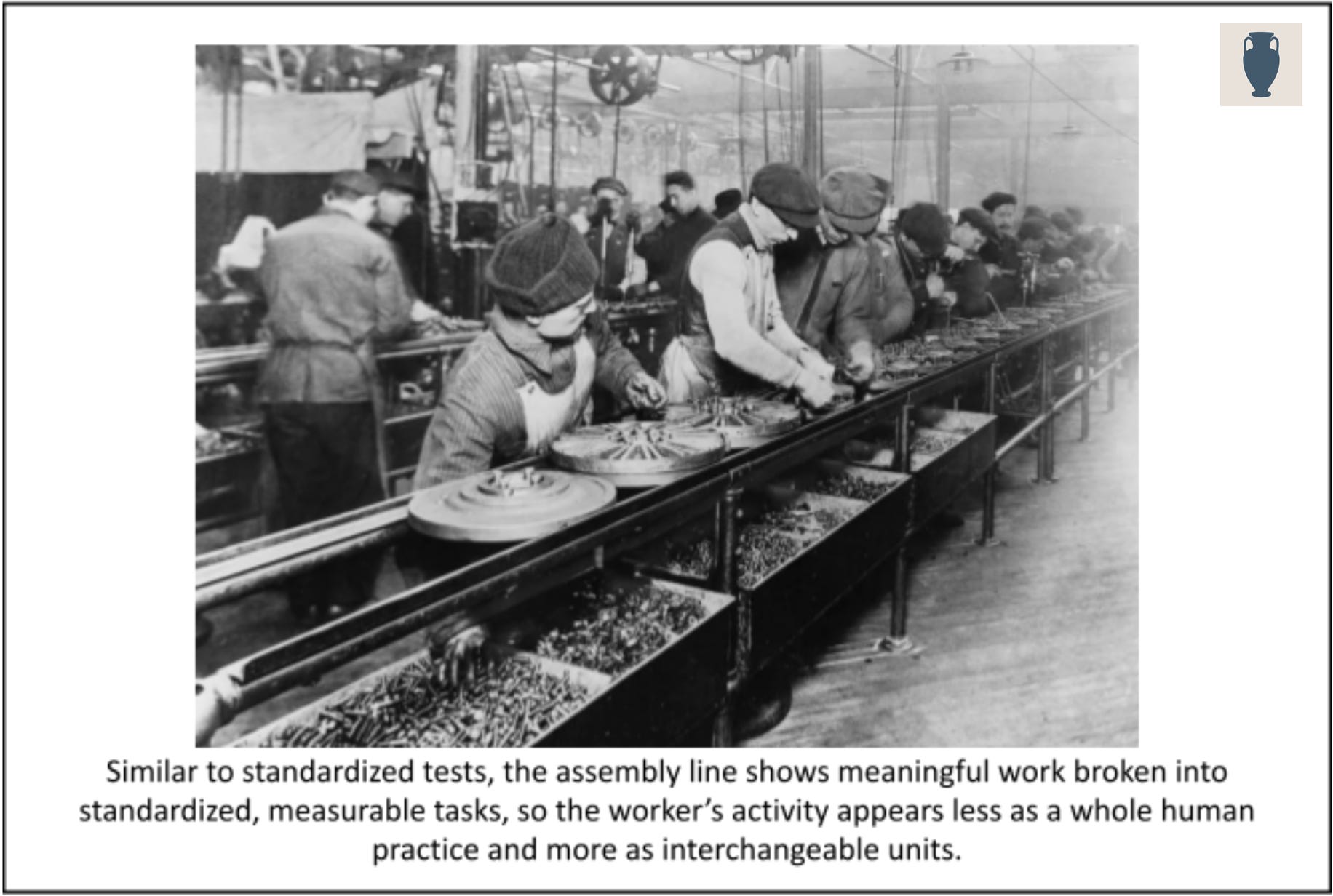
On one hand, standardized tests allow teaching to be understood in a general form: how much material was covered, whether targets were met, and how students performed on comparable assessments. In principle, these metrics can be used to compare teachers in quite different circumstances, information that is obviously valuable when hiring. But the more the activity is understood in these abstract terms, the less it is understood through the meaningful situation in which teaching actually takes place. Instead of being guided first by the question, “What do these students need in order to understand this material?”, the teacher is increasingly pushed toward the question, “How do I produce the measurable outcome?”
We can see the significance of this shift more clearly in a specific example. Suppose a teacher realizes that one student in the class is having a hard time understanding a theme in a book they are covering. If teaching were organized around the concrete needs of the classroom, the teacher can begin a back-and-forth dialogue with the student, trying to understand the specific shape of the student’s confusion and engaging with them in a way tailored specifically to this student’s needs. But when the teacher’s labor is commodified, and the focus shifts to abstract and generalizable metrics like standardized tests, engaging the student in that meaningful way is no longer the priority. The teacher, understanding that they are assessed by these abstract metrics like standardized tests, instead tells the student to simply memorize a pre-determined answer that highlights the theme and explanation of the book, so that the answer can be replicated correctly on the standardized test. Rather than remaining immersed and responsive to the concrete situation, the teacher becomes a conduit for information passed from administration to student, separating them from meaningful engagement. In fact, even the goal of the student’s learning is subordinated to quantifiable results. As a result of the abstraction necessary for commodification, the meaning of the activity for the worker, as well as the worker’s effectiveness in its original purpose, is diminished.
III. Democracy
Of course, some degree of abstraction is necessary in modern economic life. Large-scale production requires these generalizable and quantifiable measures to aid in dealing with the complex problems we face today. The problem, then, is not abstraction as such. The problem arises when abstraction becomes so dominant that the activity is no longer guided primarily by its concrete purpose, but by external standards that have become detached from the work itself. What needs to be addressed is not the mere existence of abstraction, but the way it can override the meaningful activity from which work originally gets its point.
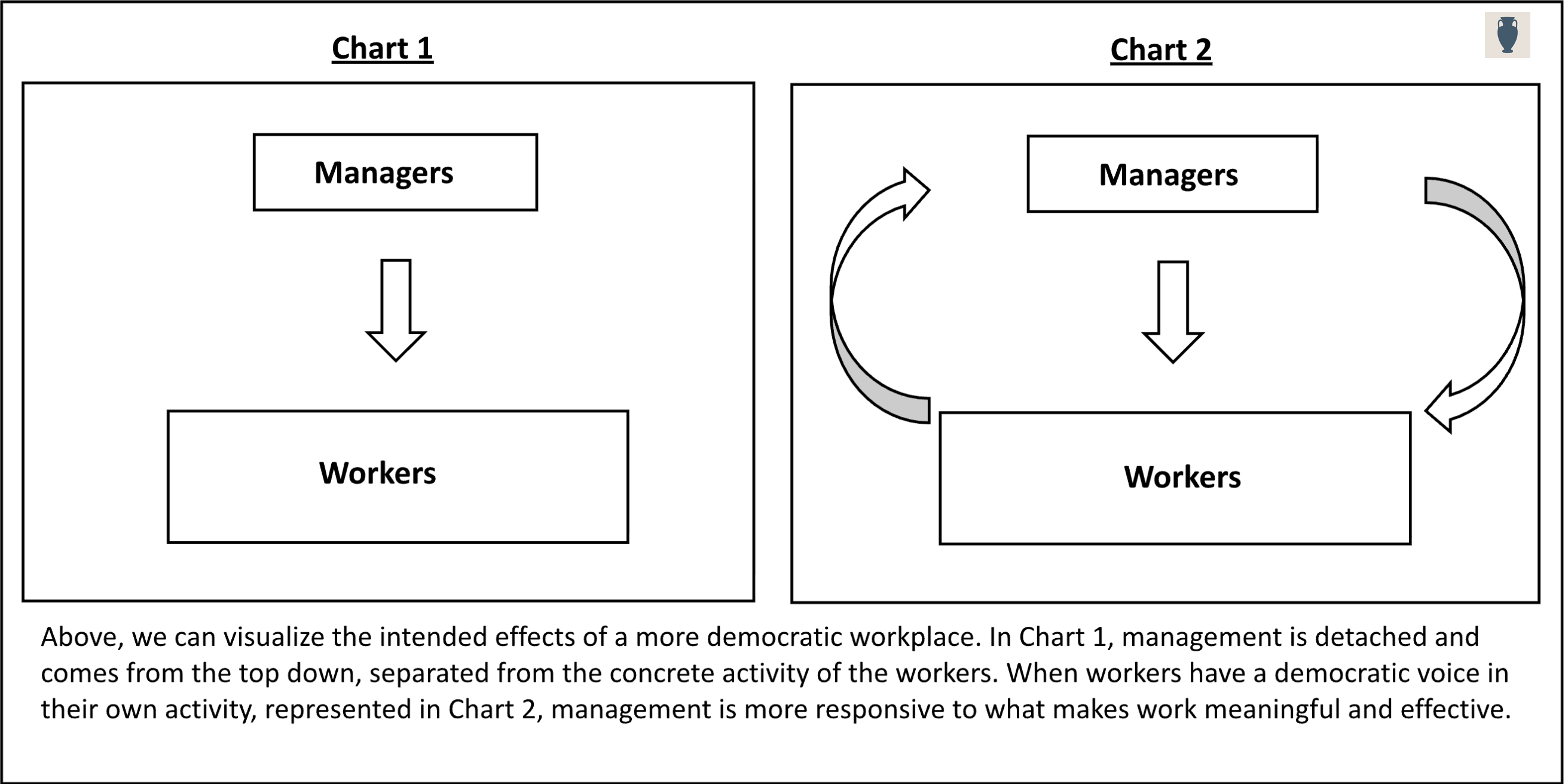
This is where democracy becomes important. Democracy in the workplace does not eliminate abstraction, nor does it return us to a world of purely artisanal production. Instead, it offers a countertendency. A democratic workplace gives workers greater power to shape the goals, standards, and organization of their own labor. In doing so, it allows the concrete know-how of those performing the work to push back against abstract forms imposed from those uninvolved. The point is not that every worker always knows best in every respect, but that meaningful activity and purpose are more likely to be preserved when the people immersed in the task have a real role in defining how it is carried out.
Workplace democracy would therefore not only make the labor process more participatory for its own sake; it would also make work more meaningful in Heidegger’s sense by keeping the activity answerable to the concrete situation from which its meaning arises. Including workers’ voices in production allows the process to remain responsive to the concrete situation as it is understood by those immersed in the work itself.
In the case of teaching, this would mean giving teachers a real role in shaping curriculum and assessment, rather than having those structures imposed in a standardized way from above. In such a setting, not only would the teacher relate to their activity more meaningfully, but they will also be better able to respond to the real needs of the classroom rather than being forced to orient the activity around what can be most easily measured.
Conclusion
The central claim of this paper has been that the meaning of work comes not from an abstract value attached to it from the outside, but from the worker’s involved participation in an activity that makes sense from within. Heidegger helps us see that meaningful activity is qualitative, purposive, and responsive to the concrete situation at hand. Wage labor, by contrast, abstracts from this source of meaning by treating labor-power as something that must be quantified, compared, and managed across cases. The result is that work becomes less responsive to its own internal purpose and less meaningful for the worker. Workplace democracy offers a way to resist this tendency, not by eliminating all abstraction, but by ensuring that the organization of labor remains answerable to those immersed in the work itself. If the meaning of work arises from within activity, then a more democratic workplace is better suited to preserving the very conditions under which work can be meaningful and effective in the first place.
Joshua Richter is a graduate of Emory University, with a degree in economics, minoring in physics. His interest in philosophy kicked off in 2020 and he hasn’t stopped since. His primary philosophical interests include Phenomenology, Pragmatism, and Marxism.

Great read.
I am admittedly not one well-read in phenomenology, but I believe there to be a parallel in something I've read in an adjacent text. Specifically, the idea that the specialization of labor post-industrial revolution has separated a human's work from their worth.
The "specialist" is someone who has handed over responsibility for most of life to other specialists. The eater no longer knows the grower; the grower no longer knows the soil as a living thing but as an input; health is delegated to doctors, food to corporations, thought to academics. Each specialist does one thing efficiently and is ignorant of, or indifferent to, the consequences of that thing on the surrounding whole. This produces a person who is competent in one narrow slot and dependent/helpless everywhere else.
Labor becomes something done for a wage in one compartment of life, while meaning, care, household, and place are supposed to happen in some other compartment. This division is false and harmful, in his (and my) view.
His ending point is this: Good work is work in which the doer can see and take responsibility for the effects, work connected to a place and a community, and a standard of care that isn't purely economic.
I can't help but agree with this. While the language may be different between your piece and Berry, the pragmatic result is that people feel disconnected from their work via the abstraction of their labor.
Thank you for writing this phenomenological exploration of work and meaning. Although I agree that phenomenology is an apt tool to diagnose the seeming degeneracy of social meaning in today's generation of workers, I would reframe the problem slightly differently, perhaps even further invigorating the need for change you presented in III. Democracy.
Using Heidegger's interpretation of meaning from the situated experience, a worker would derive meaning from their work precisely from the lived experience of the work; that is, the accumulated whole of the tasks they perform, the thoughts driving the motivations behind the work they do, the feelings they feel upon doing the work, among other aspects of the experience. I would argue that these phenomenological monads are not absent in a 'commodified' work environment, such as that of the teacher who primarily aims to teach to standardized test scores. Rather, meaning for this teacher is derived from their very experience in improving (or attempting to improve) their class's standardized test scores.
Perhaps not all of us have had the fortune of having been a teacher, but let me demonstrate the example of a student to bring this phenomenological point to life. We all may readily recall the example of the 'pitch perfect' student who, fighting against the torrents of the unwieldy expectations of their parents, is so apt to achieve top-of-the-class grades. Their lives revolve around their ability to master examinations, especially the standardized ones, for which work ethic through hours of practice is rewarded. Their whole meaning of the school experience, practically, then, revolves around their experience in the pursuit of high grades. Their self-esteem is intricately tied to their ability to achieve high grades; their frustrations are voiced against perceived unfairness in the system for grades (e.g., cheating students, students taking easier classes). I would argue this itself is a phenomenology that, for this high-achieving student, is just as real as the phenomenology of a normal student who lives the holistic school experience and derives meaning from its holistic aspect (including the social, athletic, etc.).
What this entails, however, is a system of incentives that drives the lived experience in the first place. This high-achieving student was motivated to dedicate their entire school experience to academics due to the existence (or even perceived existence) of a system that ultimately rewards this behavior: good grades = good college = good work = good life. Taking Heidegger's supposition that meaning is derived from the lived experience itself, this implies that the system presupposes phenomenology. That is, in a classic chicken-and-egg fashion, the system came first, helping design the behaviors of the student that would ultimately lead to their phenomenology. Even if the student refused to submit to the idea that their meaning is derived from this flawed system of good grades = good life, the existence of this system helped motivate their behavior, which ultimately shaped their phenomenology.
This is where I would agree with the point made by fellow commenter Gregory Sparzo, in which he argues that democratic voice is insufficient. The more relevant question for me is how we can rethink the institutional system that shapes behavior in the first place. Presumably, the student had full autonomy in shaping their school experience, and out of this liberty was born their decision to dedicate their life to becoming an academic weapon. Whether this is a good or bad thing is a separate discussion. But what is clear is that the phenomenology of this 'commodified' student is vastly different than that of the student partaking a Humboldtian vision of education.