

Sleep never came naturally to me. As a young child I refused to do it and had to be taken to a sleep clinic, which, in retrospect, seems like a lot of institutional firepower to bring against a kid with a reasonable philosophical objection.
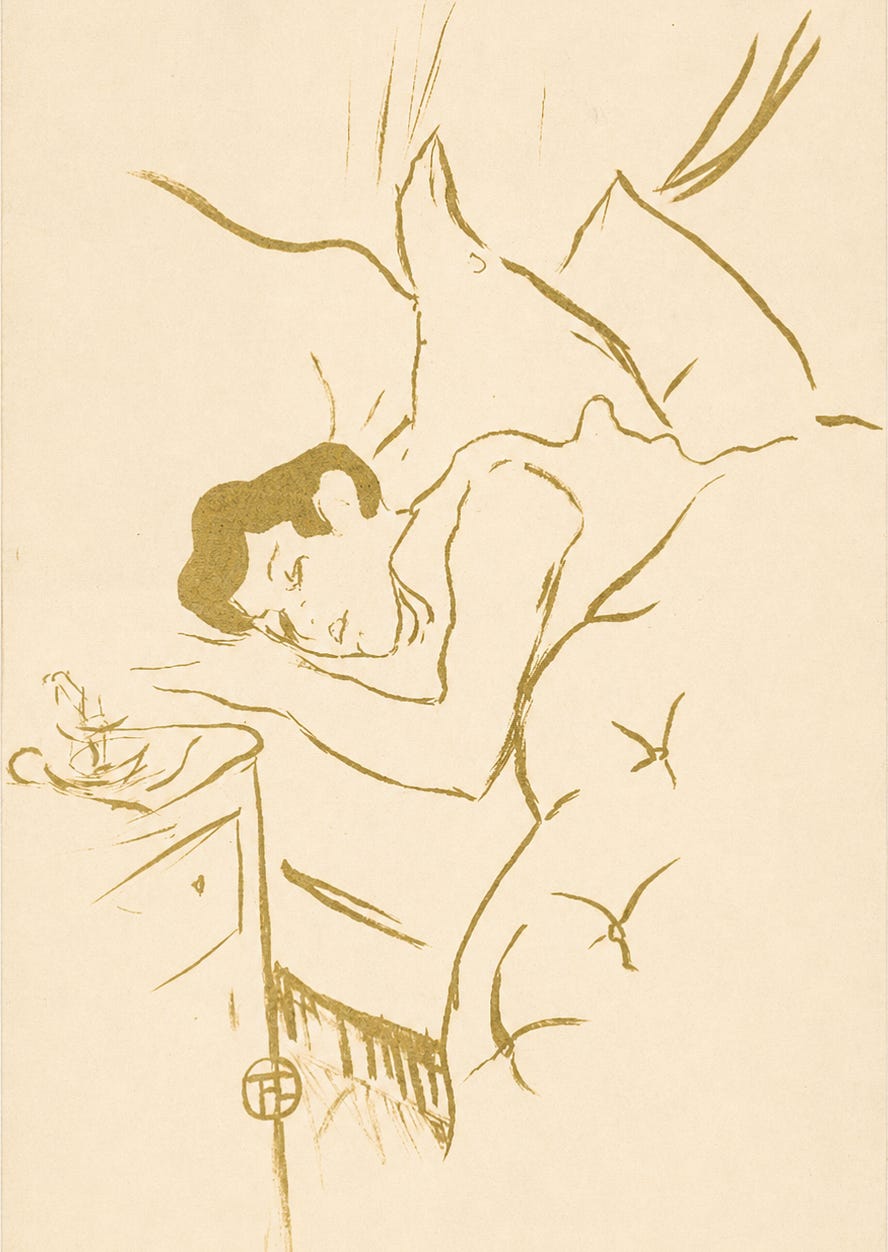
I wanted to know why we need to sleep. The answers I got: because resting makes us feel good (no it doesn’t, because I’m not conscious of it); because we need to recharge (fine, but why do we need to recharge? Seems like a bit of a design flaw); because that’s just how it is, now go to bed. I maintain, it just doesn’t make any sense.
Here are just some of the many downsides of sleep:
Waste of time
Boring
Compulsory loss of agency (deeply illiberal)
Temporarily demoted to the cognitive tier of a houseplant
Unfalsifiable possibility of not waking up
Sleep is one of the first things we do out of pure necessity, not because we chose to, not even because our parents told us to. It’s a bit like breathing or eating. But breathing is automatic, and eating is, well, pretty enjoyable. Sleep is neither. You have to remember to close your eyes. (Unless you’re absolutely exhausted, in which case nature finally steps in and handles it for you, which is condescending.) And you get nothing out of the experience itself, because there is no experience. And yet, not only do we just accept this arrangement, we structure our entire lives around it.
If at this point you’re thinking this is an awful lot of scaffolding for a straw man, you’re right. No serious person actually argues this. Sleep presumably does all the things scientists say it does. It restores the body, consolidates memory, regulates mood, clears out whatever needs clearing out, and generally performs the unglamorous maintenance work required to keep the organism going. I do not dispute any of that.
And yet, the biological answers, however true, do not quite answer the stranger philosophical question. Why are we built in such a way that consciousness must disappear periodically?
I was recently presented with an opportunity to revisit this issue. While working a corporate job, the anti-sleep case made a quiet resurgence in my own life. Snippets of my colleagues’ lives outside the office came up in conversation: an early morning workout class, dinner plans, drinks with friends. The numbers weren’t adding up. They were in early, leaving late, and somehow still living full extracurricular lives. When, exactly, were they sleeping? As I settled into the new job and city, I began to experience it for myself. The number of hours I slept dropped to accommodate my pre- and post-work schedule and I began increasingly to think of sleep as an annoyance I had to work around. Then, coincidentally – though I’m told the Baader-Meinhof effect is to blame – I started seeing the anti-sleep case crop up online. Productivity culture had apparently merged with endurance sport, and people were bragging about surviving on ten minutes of sleep and ten Celsius energy drinks a day.
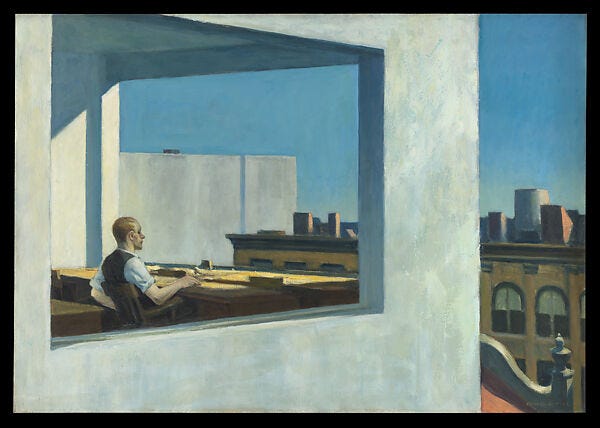
You have to admit it’s a tempting philosophy until biology shows up, as always, to wag its finger. Sleep is good for us. Drinks that are just a few pH points removed from battery acid are not. But if, hypothetically, the health impact were the same, would the finger wagging still be warranted? Wouldn’t I take the Celsius and the extra eight hours in the day? After all, the pathologically pro-productivity mindset is, I think, just an exaggerated version of a much more ordinary human impulse.
We’re supposed to chart our own paths, build the self we want. Life is like a project of self-authorship and our human bodies and waking hours are the raw material we’ve got to work with. Constraint shows up in this story as an obstacle or a test; the thing a sufficiently determined will could, in principle, overcome. Sleep frustrates that desire in the most literal possible way. It takes a finite life and makes roughly a third of it inaccessible to the person living it. Hence the “finance-bro” idea of sleep as a tax on productivity, refusable by anyone disciplined enough to try. (These are incidentally also the people most likely to own a smart mattress).
The parts of life that we don’t actively choose can generally be absorbed into the self-authorship story in two ways. One strategy is to characterize them as obstacles, overcome by determination. Whatever you don’t choose becomes a source of resistance that your strength gets measured up against. It becomes the thing you overcame. Alternatively, what is unchosen can sometimes be dressed up as choice in disguise, as when taking a break gets reframed as a strategy. You take a power nap to recharge (21 minutes exactly for the best productivity-boosting effects), you eat to refuel, you take a break from the gym and call it active recovery. You don’t just decompress, you invest.
But sleep resists this logic. It is not an obstacle to be overcome, because no degree of disciplined willing eliminates the need. Nor can it be framed as a strategic choice, because biological necessity will override our decision should we choose to abstain from it. Every night, for roughly a third of our lives, we are returned to a state we did not choose and cannot refuse. There’s nothing strategic about it. And unlike power naps, we don’t choose to press the pause button on consciousness every night, we come into the world pre-programmed to do so. If selfhood is about self-authorship, the sleeping subject barely qualifies as a self at all.
Nor will it do to say that sleep is just one bodily process among many. Digestion is also unchosen and unavoidable, but it runs quietly beneath the authoring self while the authoring goes on. Sleep does not operate under the self; it suspends it. And it takes its payment in the only currency the self-authorship story counts, claiming a third of the hours the author was planning to use.
The question remains, does this reveal a defect in sleep or in the self-authorship story? Aside from the fact that it feels strange to treat a third of our existence as a design flaw to be minimized, I think there are good reasons to see sleep as being more than just a biological oddity. Considered together, they suggest that the self-authorship story is incomplete.
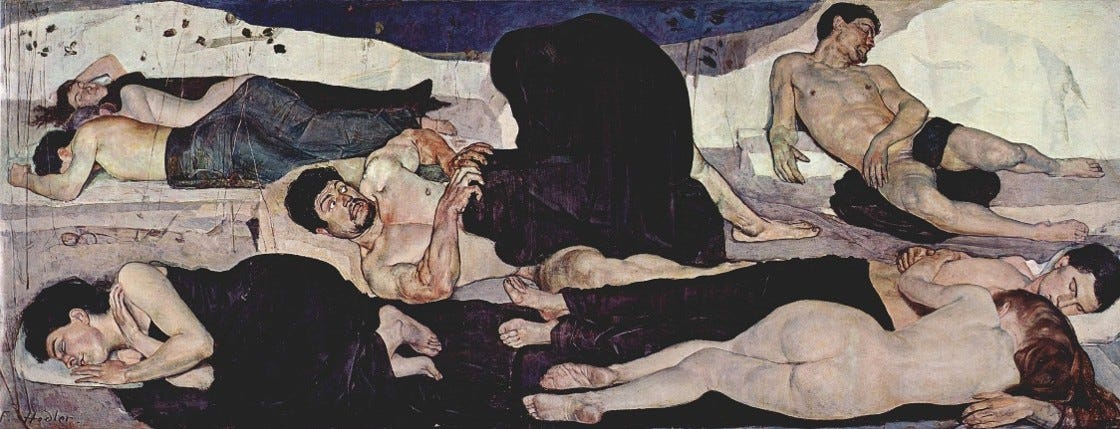
The first has to do with the universality of the experience. Sleep is one of the few things we all have in common, which makes it a fundamental, unifying feature of what it means to be a human being. Every person who has ever lived has done it. At the end of each day, almost without fail, we lie down and surrender the thread of our own existence. That is, until we wake up and do it all over again.
Sleep is also an equalizer, and for a simple reason: sleep begins precisely where conscious effort ends. That is why none of us can do it better than anyone else, or opt out, or turn it into an achievement. Of course, the wearable health tech industry would like to disagree on that last point. But the idea that sleep is a skill that can be trained or scored hardly makes sense. A skill is something you exercise, and in sleep there is no one there to do the exercising. You wouldn’t say that someone is skilled at digesting.
I digest. I mean, digress. My point is that sleep is, or should be, one of the few things we do that is untouched by the heroic efforts we direct at differentiating ourselves and curating our lives. It is fundamentally non-volitional and non-performative. When we sleep we are temporarily stripped of all of our waking worries, ambitions, and the social or professional identities we cultivate and wear. The sleeper is the subject with all performance and artifice removed and, in that sense, sleep offers the clearest look at what the self-authoring self actually is at its core. Indeed, somewhat paradoxically, the condition in which conscious agency is entirely absent is also the one that exposes our most irreducible, shared human baseline.
But now connect these two features to a third, the fact that sleep is also fundamentally a limit. Indeed, as I have been belabouring for some time now, that is perhaps its most central, and strangest feature. Sleep is one of the most constant and powerful reminders that we are creatures with certain inescapable limitations; that we are only human. We are not machines. In an era of unprecedented longevity and medical advancement, it is easy to forget that we don’t have complete dominion over our bodies. And yet, every night, in full possession of our faculties, we lose possession of them. Not because we really want to, but because biology ordains it.
Taken together, these features show that what makes sleep so fundamental to human existence is also what makes it so strange. Sleep is at once a universal, deeply human experience and a constraint. What lies at the core of our common humanity when everything else is stripped away is not a capacity but a limit. The mistake the self-authorship story makes is in imagining human beings as selves first and constrained creatures second.
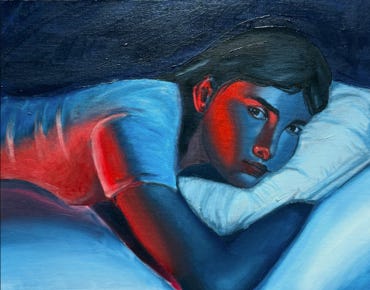
Of course, none of this explains why we are programmed to sleep, or why nature could not have designed us to perform the same maintenance while awake. Sleep may simply be a fact of nature, something we do not because it is philosophically elegant or personally convenient, but because this just is the kind of creature we happen to be. Still, even if sleep is a brute biological fact, the fact that is both profoundly unproductive and absolutely indispensable is instructive. It shows us that any description of ourselves or life in general that is purely in terms of our productivity leaves out something fundamental about the kind of creatures we are.
The self-authorship story cannot account for sleep because it assumes that anything we didn’t choose must be either an obstacle or a choice in disguise. But sleep is a third thing: a constraint that is partly constitutive of the self it appears to constrain. Indeed, there is no version of you that exists prior to the need for sleep and is merely inconvenienced by it. The constraint is not an intrusion on the self, it is a feature of it. In this sense, sleep is the daily rehearsal of a fact we otherwise spend enormous energy denying, that surrendering to something we cannot control is not a failure of the self but a condition of having one.
This is, I’ll admit, a more generous conclusion than six-year-old me would have accepted. She would have pointed out, correctly, that I still haven’t really answered her question. What I have offered is an interpretation, and a somewhat fanciful one at that. Unfortunately for her, she did not grow up to be a STEM person with access to those kinds of answers.
Grace Theodoly is a law student at Stanford Law School and holds a B.A. in Philosophy from the University of Chicago. Though she currently studies law, she continues to read and write about philosophy in her spare time, with particular interests in epistemology, metaphysics, and the philosophy of mind.


Unfortunately some of us have insomnia so it’s not universally as involuntary as you might think. Also the sleeping itself isn’t a skill, but promoting sleep through sleep hygiene I’d say requires some acquired habits and choices. But I get your general point.
Sleep has always been a topic I had an interesting relationship with, and this article makes me acknowledge that while also having a nice laugh at myself. Very cool!