


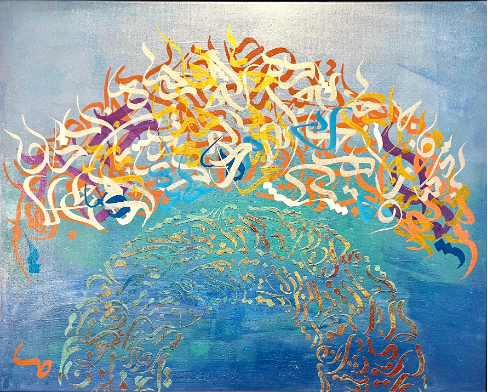
I never knew how Rumi became so internationally renowned. Growing up in Iran, reading his poems and knowing him simply as “Moulana,” I had no idea that his fame had eclipsed that of other great Persian poets in international realm. Perhaps it’s largely due to the wondrous love story behind the thousands of verses he left behind.
Rumi was born in Balkh (in present-day Afghanistan), when he was still a child, his family self-exiled to Konya (in present-day Turkey), driven by a combination of religious oppression, spiritual longing and political instability. This journey would ultimately shape the mystic we now know as Rumi.
Rumi succeeded his father as a religious teacher and spiritual guide in Konya. He was already well-educated in Islamic jurisprudence, theology, and Sufism, and had become a highly respected theologian in Konya. But everything changed when he met Shams al-Din Tabrizi, a wandering dervish from Tabriz (in present-day Iran).
“From Tabriz, my Shams (sun) appears to me like the new moon.
Turn your gaze to the true Light, not to borrowed glow.”
Their encounter was like lightning—soul-shaking, intimate, and transformative. Rumi would later write:
“By the souls of all who’ve given theirs, I swear—my soul is his.
By the souls of the redeemed, I swear—I am delivered through him.”
Throughout their companionship, Rumi underwent a radical transformation—from a highly regarded Islamic scholar to a wandering Sufi, no longer concerned with reputation or social status. He even became the subject of public ridicule. Stories tell of children throwing trash at him while he wandered the streets, lost in ecstatic devotion. And Rumi embraced this loss of formality, ego, and pride, writing:
“I was a pious person, you turned me into singer (of love songs).
You made me the source of mischief in the tavern, and a restless seeker of wine
I used to be a dignified worshipper
You turned me into a laughingstock for the children playing in streets.”
I don’t want to delve too deeply into how they connected through a shared passion for mysticism and divine love. Instead, I want to reflect on the nature of their friendship, how their presence with one another enabled a kind of authentic communication that few ever experience. Even someone uninterested in mysticism might feel envious of the deep connection Rumi found in Shams. Isn’t that what many of us long for? In a world of over 8 billion people, how many of us have found that one true friend with whom we experience the joy of being fully understood? If you are one of them, consider yourself lucky!
Much speculation exists about the nature of their intense and mysterious relationship—from spiritual companionship to romantic or even homoerotic love. But does it matter? What truly matters is that once upon a time, there was an encounter—what existentialism might call authentic communication—between two strangers. Their bond was so powerful that centuries later, we still find it awe-inspiring.
Martin Heidegger, one of the most influential philosophers of the 20th century, extensively discussed the idea of authentic communication. For Heidegger, authentic communication is a profound openness, that allows the human being (Dasein) to disclose itself. He called this form of existence, being-with (Mitsein)—a mode of relating that enables each person to exist more fully in their own truth. It’s not about convincing the other; it’s about revealing Being.
Heidegger contrasts this with “idle talk” (Gerede). The phenomenon of “Idle Talk” is oriented toward understanding Dasein in its mode of “everydayness” (Alltäglichkeit) and its “publicness” (Öffentlichkeit) which contains most of our everyday conversations—about the weather, work, politics, inflation, and so on. Idle talk is part of what he calls the structure of fallenness (Verfallen), in which we become lost in the routines and concerns of the world, absorbed in the anonymous collective he names das Man (”the they”).
“Idle talk is the way in which discourse is expressed in publicness. It is not meant to be a groundless kind of talking, but it serves to make the world accessible in an average way.”
— Being and Time, §35.
So, Idle talk isn’t meaningless—it helps us navigate daily life. But problems arise when it becomes a substitute for genuine understanding:
“By repeating what is said, it prevents any new inquiry and any kind of genuine understanding.”
— Being and Time, §35
Authentic communication emerges from a place of resoluteness (Entschlossenheit). It happens when we confront our thrownness (Geworfenheit), our mortality, our anxiety, and take ownership of our existence. From that place, we speak with clarity, depth, and care. Authentic communication is not just about self-expression, it is also relational—it invites the other person to stand in their own truth. It reveals Being, grounded in experience and openness to the truth of our nothingness, mortality, and shifting moods.
It seems that Rumi and Shams found this kind of rare communion—and left behind a luminous example of what authentic communication can be.
When Shams disappeared, Rumi was devastated. There are many theories about his fate—some claim he was murdered by those who disapproved of their bond, possibly even by Rumi’s own son; others suggest he returned to his hometown in silence. But one thing is certain: Rumi made it abundantly clear, through thousands of verses written after Shams’ disappearance, that he had found an authentic companionship. Their conversations and the depth of their connection would never be lost to the world.
Sanam Ghandehari is an immigration attorney, writer, and visual artist whose work explores love, the reality of being, and the depth of human connection. She is particularly interested in bridging Eastern literature and mysticism with contemporary philosophical thought and artistic expression. She lives and works in New York, where she balances legal advocacy with creative and philosophical inquiry.
I like this article. Thank you for putting it together.
In psychoanalysis authentic communication is everything- but it’s also the most painful and paradoxically lonely thing.
The problem with idle talk is not that people consciously desire to replicate small talk, but that it has subconsciously replaced their idea of what conversations should look like. As humans, we are fickle creatures in our inability to escape habit -- it is very hard for us to believe that authentic communication is what we should consistently fight for if, by the nature of our society and its conversations, we strike idle talk through habit. One must wonder if there is a way to re-engineer society such that idle talk does not become the default of our penchants for conversation.